Band 5.5 IELTS Writing Task 1 Model Answer
Overall Band Score: 5.5 · Cambridge IELTS 14 · 2026-11-13
IELTS Writing Task 1 question
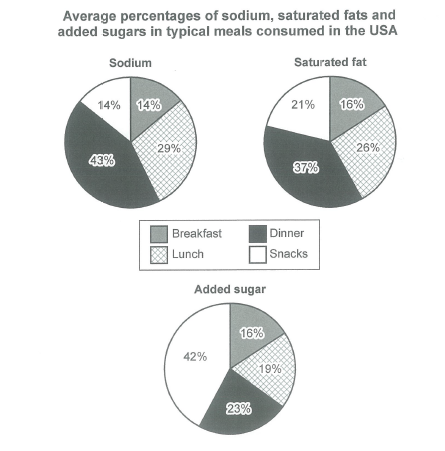
The charts below show the average percentages in typical meals of three types of nutrients, all of which may be unhealthy if eaten too much.
Summarize the information by selecting and reporting the main features, and make comparisons where relevant.
Student answer (Band 5.5)
The charts illustrates the propostion of nutrients including sodium saturated fat and sugar. If it is used in large amount, it become harmful
overall, Higher amount of sodium is used in dinner. Similarly, more quantity of sugar is added in snacks. While, small proportion of all nutrients are used in breakfast. snack contain are harmful amount of sugar, so it cause disases.
Looking closely at demograghics, breakfasts have few amount of all three nutrients, having 14 percent sodium and 16 percent saturated fat and sugar. Conversely, dinners contain huge quantity of sodium, which is 43 percent and saturated fat which covers 37 percent, but it only have 23 percent sugar.
Turning to remaining food, lunch have 29 percent sodium, 26 percent saturated fat and 19 percent sugar. Additionally, snacks the figure of sugar is much higher in snack,which is 42 percent and small amount of sodium and saturated fat proportion is 14 and 21 percent respectively.
AI examiner evaluation
| Criterion | Band |
|---|---|
| Task Achievement / Task Response | 6.5 |
| Coherence and Cohesion | 6.0 |
| Lexical Resource | 5.0 |
| Grammatical Range and Accuracy | 5.0 |
| Overall | 5.5 |
Task Achievement / Task Response: Band 6.5
You identify the main contrasts accurately: dinner has the highest sodium and saturated-fat shares, while snacks lead in added sugar, and breakfast is low across the three nutrients. The figures you give for each meal are also consistent with the chart. This provides a clear overview and relevant supporting detail. However, the overview says breakfast has a “small proportion of all nutrients,” which is broadly true but could be more precise, and the comment that snacks contain “harmful amount[s]” adds an unsupported health judgement rather than describing the data. To strengthen the response further, keep the focus consistently on comparisons and make the overview more complete—for example, note that dinner is highest for two nutrients, whereas snacks are highest for the third.
Coherence and Cohesion: Band 6.0
The response has a recognisable structure: an introduction, an overview, and paragraphs comparing breakfast and dinner, then lunch and snacks. This makes the information generally easy to follow. You also use linking expressions such as “Conversely,” “Additionally,” and “Turning to,” to signal comparisons. However, some links are mechanical or awkward, and the overview’s “While” sentence is not smoothly connected to the preceding point. The final paragraph also repeats the snack sugar comparison already made in the overview. Organise the details into a clearer sequence, such as comparing the highest and lowest meal for each nutrient, and use references like “this figure” only when their meaning is unmistakable. This would make progression more controlled.
Lexical Resource: Band 5.0
You use some relevant chart vocabulary, including “proportion,” “quantity,” “covers,” and “respectively,” and the reader can understand the main comparisons. However, the range is limited and several choices are inaccurate or unnatural: “huge quantity” is not suitable for a percentage, “few amount” is incorrect, and “demograghics” is not the right word for describing chart data. There are also spelling errors such as “propostion” and “disases,” which reduce precision. Aim for standard data-reporting collocations and accurate spelling rather than using emphatic or evaluative language. For example, describe a share as “the highest proportion” and use “accounted for” when reporting a percentage.
Grammatical Range and Accuracy: Band 5.0
You attempt a mixture of simple and more complex forms, including “which is 43 percent” and the contrast introduced by “Conversely.” However, errors in agreement, articles, and sentence construction occur across the response. For example, “The charts illustrates” should have a plural verb, while “it become harmful” needs a matching subject and verb form. In “snack contain are harmful amount,” the sentence structure is incomplete, and “dinners … but it only have” shifts between plural and singular subjects. Capitalisation after full stops is also inconsistent. These errors sometimes make the reader pause, although the intended comparisons are usually recoverable. Practise building accurate subject–verb patterns and checking each sentence for a complete clause before adding complex links.
See this exact question answered at other band scores. The same prompt compared across bands.
Browse more IELTS Writing model answers or get your own writing scored by the same AI examiner.