Band 6.0 IELTS Writing Task 1 Model Answer
Overall Band Score: 6.0 · Cambridge IELTS 14 · 2026-11-14
IELTS Writing Task 1 question
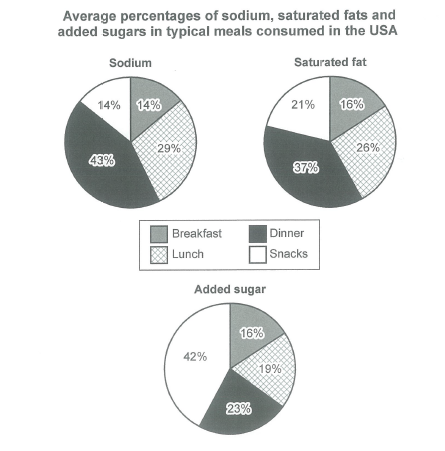
The charts below show the average percentages in typical meals of three types of nutrients, all of which may be unhealthy if eaten too much.
Summarize the information by selecting and reporting the main features, and make comparisons where relevant.
Student answer (Band 6.0)
The pie charts illustrate mean proportion of three different nutrients that's including in meals of USA citizens and discuss by four category of meal duration.
Overall, it is clearly noticeable that dinner show the highest percentages of nutrients except in adding sugar. While the percentages of the nutrients in breakfast showed the lowest share of the pie chart among other three category.
To commence with the sodium nutrient which showed the highest percentages in dinner which is 43% of the total share. The percentages of sodium in snacks and breakfast is remained same with 14% each.
moving further with the saturated fat which is also highest in dinner with 37% . While, breakfast showed the lowest share with 16%. The lunch meals have more fat in compare to snacks by difference of 5%.
At last, the proportion of the sugar including meal, 42% of population use adding sugar during snacks time People prefer sugar during breakfast and lunch with 16% and 19% respectively.
AI examiner evaluation
| Criterion | Band |
|---|---|
| Task Achievement / Task Response | 6.5 |
| Coherence and Cohesion | 6.5 |
| Lexical Resource | 5.5 |
| Grammatical Range and Accuracy | 5.5 |
| Overall | 6.0 |
Task Achievement / Task Response: Band 6.5
You identify the main pattern that dinner accounts for the largest shares of sodium and saturated fat, and you correctly note that added sugar is highest in snacks. Several figures are also reported accurately, including dinner sodium at 43%, breakfast and snacks sodium at 14% each, and snack sugar at 42%. This gives the response a relevant overview and covers the three nutrients. However, the overview says breakfast has the lowest share among the meal categories, which is not true for every nutrient: snacks are equally low for sodium, and breakfast is not the lowest for added sugar. The sugar paragraph also omits dinner’s 23%, an important comparison. A more precise overview and fuller coverage of the key contrasts would strengthen the report.
Coherence and Cohesion: Band 6.5
The response has a clear overall structure: an introduction, an overview, and separate paragraphs for sodium, saturated fat and sugar. This makes the information easy to follow, and sequencing phrases such as “To commence with” and “At last” signal movement between topics. Some linking is mechanical or awkward, however, and the final paragraph runs several ideas together without clear punctuation. The transition “While” also introduces a fragment rather than a complete contrast. In addition, the overview’s broad statement about breakfast does not align neatly with the later figures. Use more natural transitions and ensure each paragraph develops a clear comparison; this would make the progression more consistently smooth.
Lexical Resource: Band 5.5
You use relevant chart vocabulary, including “proportion,” “percentages,” “highest” and “lowest,” so the reader can understand the main comparisons. However, several word choices and collocations are noticeably inaccurate or unnatural, such as “meal duration,” “adding sugar,” “use adding sugar” and “the sugar including meal.” “Mean proportion” is also an awkward way to describe the chart’s average percentages. These choices sometimes make the intended meaning less clear, particularly in the introduction and sugar paragraph. Aim for precise, conventional expressions for meal categories and nutrient shares, and avoid repeating “share” and “percentages” when a more exact term is available.
Grammatical Range and Accuracy: Band 5.5
You attempt both simple and more complex sentence forms, including contrasts introduced by “While,” and most of the data remains understandable. However, errors in agreement, verb forms and sentence construction are evident: “dinner show” should have a singular verb, “which is including” is not a correct clause, and “is remained same” uses an incorrect verb form. The sentence beginning “While, breakfast showed…” is incomplete, and the final sentence needs punctuation to separate its ideas. These errors show that complex structures are not yet consistently controlled. Check subject–verb agreement and verb forms, and make sure every contrast clause is attached to a complete sentence.
See this exact question answered at other band scores. The same prompt compared across bands.
Browse more IELTS Writing model answers or get your own writing scored by the same AI examiner.