Band 5.5 IELTS Writing Task 1 Model Answer
Overall Band Score: 5.5 · Cambridge IELTS 14 · 2026-11-14
IELTS Writing Task 1 question
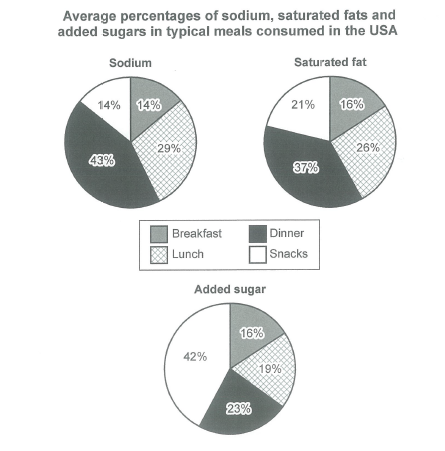
The charts below show the average percentages in typical meals of three types of nutrients, all of which may be unhealthy if eaten too much.
Summarize the information by selecting and reporting the main features, and make comparisons where relevant.
Student answer (Band 5.5)
These pie charts illustrate the average proportions in typical meals of three types of nutrients in the USA, potentially causing health problems if eaten excessively.
Overall, at dinner, meals consist major proportions of sodium and saturated fat. snacks have the biggest proportion of added sugar while breakfast have similar percentage of all types of nutrients.
Sodium and Saturated fat have similar proportions of all typical meals, which dinner gain the largest proportion, at 43% and 37% respectively. Sodium in snacks and breakfast is equal to 14%
most of added surgar is in snacks, which is 42%, compared with sodium and saturated fat, which are 14% and 21%, respectively. All three types of nutrients have similar proportion in breakfast which is in the range of 14-16%.
AI examiner evaluation
| Criterion | Band |
|---|---|
| Task Achievement / Task Response | 5.0 |
| Coherence and Cohesion | 5.5 |
| Lexical Resource | 5.5 |
| Grammatical Range and Accuracy | 5.0 |
| Overall | 5.5 |
Task Achievement / Task Response: Band 5.0
You identify the main pattern that dinner has the highest shares of sodium and saturated fat, and that snacks lead for added sugar. You also include several accurate figures, such as dinner’s 43% sodium and 37% saturated fat, and the 42% added sugar in snacks. However, the report is incomplete: lunch receives little attention, and the comparison that sodium and saturated fat have “similar proportions” is too broad because their meal-by-meal figures differ. The overview also says breakfast has similar percentages, but does not clearly explain that all three values are low there. The response is 117 words, below the 150-word minimum; the eight words copied from the prompt are excluded. Add a fuller comparison of lunch and develop the overview.
Coherence and Cohesion: Band 5.5
The response has a basic, useful structure: an introduction, an overview, and two paragraphs of supporting details. This makes the main message reasonably easy to locate. However, progression is limited because the final two paragraphs do not clearly organise the data by nutrient or meal, and the second detail paragraph repeats the breakfast comparison already made in the overview. Some links are awkward or unclear, particularly “compared with sodium and saturated fat,” where the intended comparison between nutrients in snacks could be stated more directly. The missing full stop after the sentence about sodium in snacks and breakfast also weakens the flow. Grouping the figures consistently—for example, dinner and snacks first, then breakfast and lunch—would create clearer progression.
Lexical Resource: Band 5.5
You use relevant chart vocabulary, including “average proportions,” “largest proportion,” and “respectively,” and the meaning is generally understandable. However, the range is limited and some word combinations are unnatural, such as “meals consist major proportions” and “dinner gain the largest proportion.” “Most of added surgar” also contains a spelling error and an awkward phrase, while “all typical meals” is imprecise when you mean the meal categories. These issues make the description less clear and controlled, though the key data can still be followed. Aim for accurate collocations such as “account for the largest share” and use precise terms like “meal types” or “meal categories.” Check spelling carefully before submitting.
Grammatical Range and Accuracy: Band 5.0
Your response includes simple statements and some attempts at more complex structures, such as “which is 42%, compared with…,” but grammatical control is inconsistent. Errors include subject–verb agreement in “breakfast have” and “dinner gain,” missing articles in “at dinner” and “the biggest proportion,” and the faulty construction “meals consist major proportions.” The sentence beginning “Sodium and Saturated fat have similar proportions…” is also incomplete or poorly connected at “which dinner gain…”. Capitalisation and punctuation are inconsistent, including the lower-case start of “snacks” and the missing full stop before “most.” These errors sometimes make relationships between figures harder to understand. Practise complete comparison sentences with accurate agreement and articles, then proofread each sentence for punctuation.
See this exact question answered at other band scores. The same prompt compared across bands.
Browse more IELTS Writing model answers or get your own writing scored by the same AI examiner.