Band 5.5 IELTS Writing Task 1 Model Answer
Overall Band Score: 5.5 · Cambridge IELTS 14 · 2026-11-14
IELTS Writing Task 1 question
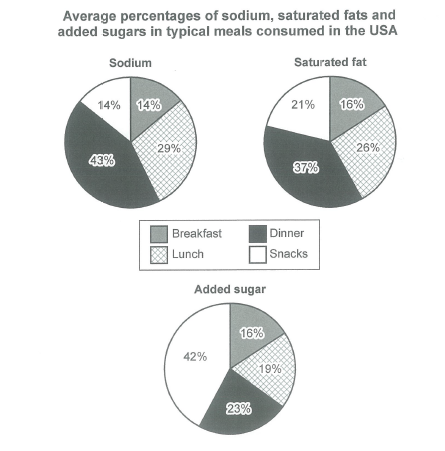
The charts below show the average percentages in typical meals of three types of nutrients, all of which may be unhealthy if eaten too much.
Summarize the information by selecting and reporting the main features, and make comparisons where relevant.
Student answer (Band 5.5)
The pie charts compare the data on the average proportion in typical meals in Sodium, Saturated fat, Added sugar consumed in the USA.
Overall, the dinner and snacks had highest share in sodium and saturated fat. While, lunch and breakfast smallest shares. However, snacks share increase in added sugar.
In dinner accounted 43% in sodium, slightly deceased saturated fat and added sugar at 37% and 23% respectively. While, the second most share snacks at sodium only 29% slightly drops at 26% in saturated fat . Gradually increase in added sugar at 43%.
In contrast, breakfast at 14% in sodium , slightly rose in added sugar and saturated fat had 16%. Whenever, lunch at 14% in sodium and sharply rise in saturated fat at 21% . At the added sugar slightly decline at 19%.
AI examiner evaluation
| Criterion | Band |
|---|---|
| Task Achievement / Task Response | 5.0 |
| Coherence and Cohesion | 5.5 |
| Lexical Resource | 5.5 |
| Grammatical Range and Accuracy | 5.0 |
| Overall | 5.5 |
Task Achievement / Task Response: Band 5.0
You identify the broad contrast that dinner is important for sodium and saturated fat, while snacks lead for added sugar, and you include several figures. However, some key data are misreported: sodium at snacks is 14%, not 29%, and lunch is 29%, not 14%; saturated fat at lunch is 26%, not 21%. The overview also says lunch and breakfast have the smallest shares, although this is not true across all nutrients. These inaccuracies and the limited coverage make the summary only partially successful. The response is also 17 words below the required minimum. Check each chart segment carefully, then add accurate comparisons—for example, dinner has the highest sodium and saturated-fat proportions, whereas snacks have the highest added-sugar proportion.
Coherence and Cohesion: Band 5.5
The response has a basic paragraph structure, moving from an introduction and overview to details, and contrast markers such as “Overall” and “In contrast” show an attempt to organise comparisons. However, the progression is difficult to follow because the meal categories and nutrient figures are sometimes mixed up, and the second detail paragraph does not clearly distinguish breakfast from lunch. Connectors such as “While” and “Whenever” are used awkwardly, and some sentences are fragments, which interrupts the flow. To improve, group the figures by meal or by nutrient, keep each comparison in a complete sentence, and use a small set of accurate linking phrases rather than inserting them where the relationship is unclear.
Lexical Resource: Band 5.5
You use relevant chart vocabulary, including “proportion,” “share,” “slightly,” and “decline,” and the reader can generally recognise that you are comparing percentages. However, several choices are inaccurate or unnatural, such as “deceased” for a decrease and “Gradually increase” for a single chart value. Phrases like “second most share” and “had highest share” also show limited control of collocation, while repeated use of “share” reduces variety. Aim for precise reporting verbs and natural comparison phrases, such as “accounted for,” “was the largest proportion,” and “was followed by.” Check that the chosen word describes the data accurately: these charts show proportions, not changes over time.
Grammatical Range and Accuracy: Band 5.0
There are attempts to use more than simple statements, including contrast clauses beginning with “While” and “In contrast,” but many sentences are incomplete or contain frequent grammatical errors. For example, “In dinner accounted 43%” lacks a clear subject and correct sentence structure, while “the dinner and snacks had highest share” is missing an article. The sentence beginning “While, the second most share snacks” is also difficult to parse, and punctuation spacing is inconsistent. These problems sometimes make the comparisons hard to understand. Build complete sentences with a clear subject and verb—for example, “Dinner accounted for 43% of sodium”—and check articles, prepositions, verb forms, and sentence boundaries.
See this exact question answered at other band scores. The same prompt compared across bands.
Browse more IELTS Writing model answers or get your own writing scored by the same AI examiner.