Band 5.0 IELTS Writing Task 1 Model Answer
Overall Band Score: 5.0 · Cambridge IELTS 14 · 2026-11-14
IELTS Writing Task 1 question
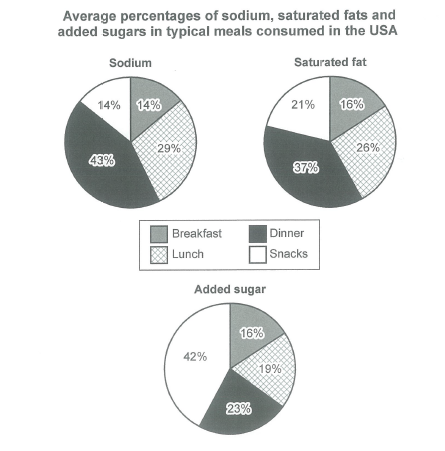
The charts below show the average percentages in typical meals of three types of nutrients, all of which may be unhealthy if eaten too much.
Summarize the information by selecting and reporting the main features, and make comparisons where relevant.
Student answer (Band 5.0)
The pie chart illustrates about the average percentage of sodium, saturated fat and added sugar consumed in typical meal in United States.
In general, the pie chart highlights about the highest consumption of sodium, saturated fat and added sugar during dinner followed by 43 percent, 33 percent and 27 percent. Moreover, the second highest consumption of sodium, saturated fat and added sugar in typical meal during lunch which held 29 percent, 26 percent and 19 percent. Furthermore the chart indicates the useage of those three components in meal during snacks with 14 percent, 21 percent and 42 percent. In addition during breakfeast people use these three compoments in their meal which held 14 percent for sodium and for both saturated fat and added sugar with 16 percent.
In conclusion the pie chart demostrates about the consumption of these 3 components in their meal in four times.
AI examiner evaluation
| Criterion | Band |
|---|---|
| Task Achievement / Task Response | 4.5 |
| Coherence and Cohesion | 5.5 |
| Lexical Resource | 5.0 |
| Grammatical Range and Accuracy | 5.0 |
| Overall | 5.0 |
Task Achievement / Task Response: Band 4.5
You identify the three nutrients and compare their shares across meals, including several accurate figures: dinner has the highest sodium share at 43%, while snacks account for the most added sugar at 42%. However, the overview incorrectly says dinner is highest for all three nutrients and gives saturated fat and added sugar figures of 33% and 27%; the chart shows 37% and 23%. The response also does not clearly highlight the key contrast between dinner being highest in sodium and saturated fat, and snacks being highest in added sugar. The conclusion merely repeats that the chart covers four meals rather than summarising its main pattern. The response is four words below the required minimum, and the limited, partly inaccurate reporting leaves the task only partially addressed.
Coherence and Cohesion: Band 5.5
The response has a recognisable structure: an introduction, a paragraph reporting comparisons, and a concluding sentence. Sequencing the meals from dinner and lunch to snacks and breakfast gives the information some organisation. However, the main paragraph reads as a series of similar statements, and the repeated connectors “Moreover,” “Furthermore,” and “In addition” make the progression mechanical rather than showing clear relationships between the data. The conclusion adds little, while the overview and detailed comparisons are not clearly separated. Grouping the figures by the most important pattern—for example, dinner’s high sodium and saturated fat versus snacks’ high added sugar—would make the progression easier to follow. Some references, such as “these three components,” are understandable but repetitive.
Lexical Resource: Band 5.0
You use relevant chart vocabulary, including “percentage,” “consumption,” and the names of all three nutrients, so the topic is generally clear. However, the range is limited and several expressions are inaccurate or awkward, such as “high consumption … during dinner followed by” and “useage of those three components in meal during snacks.” Repeating “consumption,” “meal,” and “components” also makes the description less precise. There are noticeable spelling errors, including “useage,” “breakfeast,” “compoments,” and “demostrates,” which reduce the accuracy of the writing. Aim for concise, natural reporting language and use terms such as “share,” “accounted for,” and “proportion” accurately rather than repeating the same general nouns.
Grammatical Range and Accuracy: Band 5.0
The response includes some longer sentence attempts, particularly the overview and the sentence beginning “Furthermore,” but these structures are often difficult to control. For example, “the highest consumption … during dinner followed by 43 percent” lacks a clear grammatical link between the meal and the figure, while “the second highest consumption … during lunch which held 29 percent” uses an unclear relative clause. The opening also has problems with articles and number: “the average percentage” and “typical meal in United States” need more accurate forms. Most sentences follow a similar pattern, so the range is limited, and errors in sentence construction and punctuation sometimes make relationships between ideas unclear. Practise short, complete comparison sentences before combining them.
See this exact question answered at other band scores. The same prompt compared across bands.
Browse more IELTS Writing model answers or get your own writing scored by the same AI examiner.