Band 6.5 IELTS Writing Task 1 Model Answer
Overall Band Score: 6.5 · Cambridge IELTS 14 · 2026-11-15
IELTS Writing Task 1 question
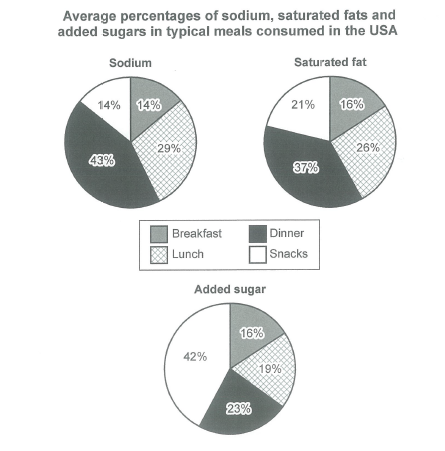
The charts below show the average percentages in typical meals of three types of nutrients, all of which may be unhealthy if eaten too much.
Summarize the information by selecting and reporting the main features, and make comparisons where relevant.
Student answer (Band 6.5)
The pie charts below illustrate the mean of the three varieties of nutrients which are considered as unhealthy in typical meals eaten by the citizens of USA and are expressed as a percentage.
Looking at the overall graphs, it is evident that percentage of sodium and saturated fats are highest in the dinner whereas added sugar presence is at the peak in the snacks.
Sodium and saturated fats contributes the highest that is 43% and 37%, respectively to the dinner. Secondly, sodium's presence in the breakfast and snacks is 14%; however it rose to 29% in the food prepared for the lunch. Second major sector consist of saturated fat is 26% which is consume as the lunch whereas 21% in the snacks. Least contribution of 16% saturated fat is witnessed for the breakfast.
42% of added sugar is found in the snacks as being the major contributor followed by the dinner at 23%. Added sugar is around 19% and 16% in the lunch and breakfast, respectively.
AI examiner evaluation
| Criterion | Band |
|---|---|
| Task Achievement / Task Response | 7.0 |
| Coherence and Cohesion | 6.5 |
| Lexical Resource | 6.0 |
| Grammatical Range and Accuracy | 5.5 |
| Overall | 6.5 |
Task Achievement / Task Response: Band 7.0
You identify the main pattern accurately: dinner has the highest shares of sodium and saturated fat, while snacks lead for added sugar. The figures you report—including 43% and 37% for dinner, and 42% for snack-related sugar—match the chart, and you cover all three nutrients with relevant comparisons. This gives the response a clear, supported account of the key features. To make the reporting more fully developed, compare the distributions across all meal types more explicitly, such as noting that breakfast is the lowest for both sodium and saturated fat, while added sugar rises from breakfast through dinner before peaking in snacks. The overview is useful, but could capture these broader contrasts rather than mainly repeating the highest categories.
Coherence and Cohesion: Band 6.5
The response has a clear overall structure: an introduction, an overview, and separate paragraphs for sodium/saturated fat and added sugar. This makes the information easy to follow, and sequencing phrases such as “Secondly” and “followed by” help signal comparisons. The organisation is coherent, though some links feel mechanical or do not precisely express the relationship between figures. For example, “Second major sector” is unclear as a transition, and “however” in the sodium sentence suggests a contrast where a straightforward comparison would be clearer. To strengthen progression, group related comparisons more deliberately and use concise linking language that shows whether a figure is higher, lower, or similar.
Lexical Resource: Band 6.0
You use a reasonable range of chart-reporting vocabulary, including “illustrate,” “percentage,” “contributor,” and “followed by,” and the meaning is generally clear. There are also attempts at more formal phrasing, such as “the peak” and “major contributor.” However, some choices are unnatural or imprecise: “mean of the three varieties” does not accurately describe the chart, “presence” is repeated where “share” or “proportion” would be more suitable, and “second major sector” is awkward. “Food prepared for the lunch” is also an unnecessarily indirect expression. Aim for standard collocations used in data descriptions, and avoid elaborate wording when a precise term such as “accounted for” or “proportion” is clearer.
Grammatical Range and Accuracy: Band 5.5
You attempt a mix of simple and more complex sentences, including a contrast introduced by “whereas” and a sentence using “however.” The main comparisons remain understandable, but some grammatical errors recur. For example, “Sodium and saturated fats contributes” has a subject–verb agreement error, and “which is consume as the lunch” contains an incorrect verb form and article use. The opening phrase “percentage of sodium” also needs an article or plural form. These issues do not prevent the reader from understanding the data, but they reduce accuracy. Check agreement with compound subjects, use consistent verb forms, and review articles and sentence punctuation. More controlled complex sentences would improve accuracy without sacrificing range.
See this exact question answered at other band scores. The same prompt compared across bands.
Browse more IELTS Writing model answers or get your own writing scored by the same AI examiner.