Band 5.0 IELTS Writing Task 1 Model Answer
Overall Band Score: 5.0 · Cambridge IELTS 14 · 2026-11-15
IELTS Writing Task 1 question
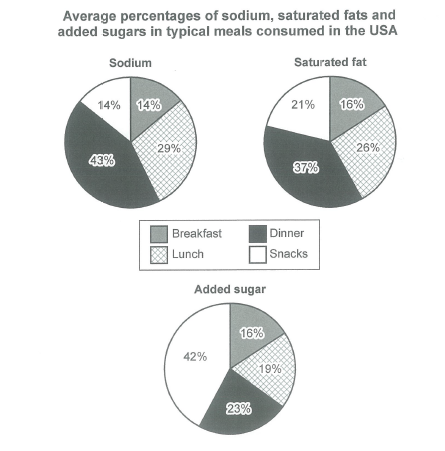
The charts below show the average percentages in typical meals of three types of nutrients, all of which may be unhealthy if eaten too much.
Summarize the information by selecting and reporting the main features, and make comparisons where relevant.
Student answer (Band 5.0)
The given pie chart elucidates information about average percentages of sodium , saturated fats and added sugars in typical meals consumed in the usa . The pie chart compares different activities to presents the data in numbers or percentages . Overall , it is clear that , there are noticeable difference shows among the activities shown in the chart . Sodium apear to be highest while , saturated fats and sugar opposite of it . According to the pie chart , the first activity sodium has used in typical meals in the usa . Sodium 14% used in breakfast , 29% used in lunch , 43% used in dinner , and 14% used in snacks . The followed by the second activity saturated fat , 16% used in breakfast , 26% used in lunch , 37% used in dinner and 21% used in snacks . Let's have a look at the remaining information , it is evident that the last activity sugar . People added sugar in his breakfast 16% , 19% in lunch , 23% in dinner and 42% in snacks . All the provided data suggests that there is no stability in all the activities .
AI examiner evaluation
| Criterion | Band |
|---|---|
| Task Achievement / Task Response | 5.5 |
| Coherence and Cohesion | 5.0 |
| Lexical Resource | 5.0 |
| Grammatical Range and Accuracy | 5.0 |
| Overall | 5.0 |
Task Achievement / Task Response: Band 5.5
You report the figures for all three nutrients across the four meals, and the values match the chart. This gives the response relevant coverage of the data. However, the overview is unclear: “Sodium appear to be highest while, saturated fats and sugar opposite of it” does not explain the main pattern accurately. Sodium and saturated fat are highest at dinner, whereas added sugar is highest in snacks; sodium is not simply highest overall. The final claim that there is “no stability” is vague and does not identify a meaningful comparison. To strengthen the summary, state these key contrasts clearly, then select a few figures to support them rather than describing each series without interpretation.
Coherence and Cohesion: Band 5.0
The response follows a basic sequence: an introduction, a general statement, and details about sodium, saturated fat, and sugar. This makes the chart’s categories identifiable. However, progression is limited because the overview does not establish a clear organising point, and the body largely lists figures in the same order as the chart. Linking phrases such as “The followed by” and “Let’s have a look at the remaining information” are awkward or conversational, while repeated references to “the activity” do not help connect the comparisons. Grouping the two nutrients that peak at dinner and contrasting them with sugar, which peaks in snacks, would create a clearer progression. Use paragraphing and concise links to guide the reader through that comparison.
Lexical Resource: Band 5.0
You use relevant chart vocabulary, including “average percentages,” “typical meals,” and the names of the three nutrients, so the topic is generally clear. However, the range is limited and several word choices or collocations are inaccurate, sometimes making the meaning difficult to follow. For example, “different activities” is not suitable for meal categories, “used in” does not naturally describe nutrient proportions, and “no stability” is not an appropriate summary of the data. There are also spelling and form errors such as “apear” and “sugar” where “added sugar” would be more precise. Aim for accurate reporting language such as “accounted for,” “was highest in,” and “the proportion of added sugar.”
Grammatical Range and Accuracy: Band 5.0
The response attempts some longer sentence forms, including “Overall, it is clear that…” and “All the provided data suggests that…,” but most reporting is built from short, repetitive clauses, and attempts at more complex structures are often faulty. Examples include “there are noticeable difference shows” and “The followed by the second activity saturated fat,” where sentence structure and agreement are unclear. Articles and possessives are also problematic in “People added sugar in his breakfast,” and punctuation is frequently misplaced, with spaces before commas and full stops. These errors can make the reader pause even though the figures remain understandable. Practise complete subject–verb sentences and use a consistent pattern, such as “Dinner accounted for 43% of sodium.”
See this exact question answered at other band scores. The same prompt compared across bands.
Browse more IELTS Writing model answers or get your own writing scored by the same AI examiner.