Band 6.0 IELTS Writing Task 1 Model Answer
Overall Band Score: 6.0 · Cambridge IELTS 14 · 2026-11-15
IELTS Writing Task 1 question
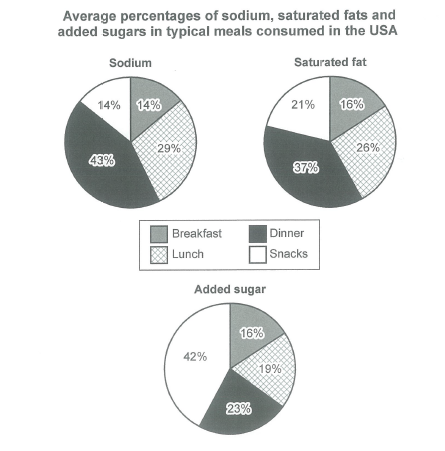
The charts below show the average percentages in typical meals of three types of nutrients, all of which may be unhealthy if eaten too much.
Summarize the information by selecting and reporting the main features, and make comparisons where relevant.
Student answer (Band 6.0)
The given pie charts illustrate that the information is about the consumption of four typical meals by people, which includes three types of nutrients namely (Sodium, Saturated fat, Added sugar). Moreover, these nutrients may be unhealthy if USA residents consume it too much in their meals.
In breakfast, around 14% of sodium, 16 % of saturated fat and added sugar was consumed by Amercians. Moreover, the percentage rose dramatically in the lunch as people consumed 29 % of sodium, 26% of saturated fat and 19% of added sugar respectively.
Furthermore, in dinner around 43% of sodium, 37% of saturated fat and 23% of added sugar people consumed in their food. However, in snacks, nearly 14% of sodium, 21% of saturated fat and 42% of added sugar people ate.
Overall, in dinner people consumed large amount of sodium and saturated fat as it covered the majority of the proporatition in the pie chart. Moreover, the consumption of saturated fat and added sugar was same in breakfast.
AI examiner evaluation
| Criterion | Band |
|---|---|
| Task Achievement / Task Response | 6.0 |
| Coherence and Cohesion | 6.5 |
| Lexical Resource | 5.5 |
| Grammatical Range and Accuracy | 5.5 |
| Overall | 6.0 |
Task Achievement / Task Response: Band 6.0
You report the figures for all four meal categories and all three nutrients accurately, including the key peaks: dinner for sodium and saturated fat, and snacks for added sugar. This gives the response relevant coverage of the charts. The overview, however, is only partly effective. The claim that dinner accounts for the “majority” is inaccurate because its shares are below half, and the final comparison about breakfast does not clearly identify that saturated fat and added sugar are both 16%. A stronger overview would summarise the contrasting patterns—dinner is highest for sodium and saturated fat, while snacks lead in added sugar—and avoid describing any share as a majority.
Coherence and Cohesion: Band 6.5
The response has a clear overall arrangement: an introduction, paragraphs covering breakfast and lunch and then dinner and snacks, followed by an overview. This makes the information easy to locate, and linking expressions such as “Moreover,” “Furthermore,” and “However” help signal progression. The organisation is coherent, though the connectors sometimes feel mechanical or do not express a meaningful contrast; for example, “However” introduces the snack figures without a clear opposing point. The overview also comes after the detailed figures and repeats some information rather than drawing the comparisons together. To strengthen progression, group the data by the nutrients’ patterns or use a concise overview before the details, with more precise links between comparisons.
Lexical Resource: Band 5.5
You use relevant chart vocabulary, including “percentage,” “consumed,” and the nutrient names, so the main information is understandable. There is some attempt at more formal phrasing, but several choices are inaccurate or awkward for describing proportions. “The consumption of four typical meals” suggests people consume the meals as a single measure, while “covered the majority of the proportion” is not a natural expression and overstates the data. Spelling errors such as “Amercians” and “proporatition” also reduce accuracy. Aim for precise reporting collocations such as “accounted for,” “the share of,” and “was highest in,” and check spelling and word forms carefully.
Grammatical Range and Accuracy: Band 5.5
You attempt both simple and more complex sentences, including clauses introduced by “which” and “as,” and the reader can generally follow the comparisons. However, some grammatical errors remain. In “these nutrients … consume it,” the plural subject does not agree with “it”; “16% … and added sugar was consumed” also has an unclear subject and verb agreement. The sentence “in dinner around 43% … people consumed” has an awkwardly placed subject, and the final sentence lacks a clear grammatical link between the two equal figures. Use direct structures such as “At breakfast, sodium accounted for 14%, while saturated fat and added sugar each made up 16%.” This would improve control while retaining variety.
See this exact question answered at other band scores. The same prompt compared across bands.
Browse more IELTS Writing model answers or get your own writing scored by the same AI examiner.