Band 5.5 IELTS Writing Task 1 Model Answer
Overall Band Score: 5.5 · Cambridge IELTS 14 · 2026-11-15
IELTS Writing Task 1 question
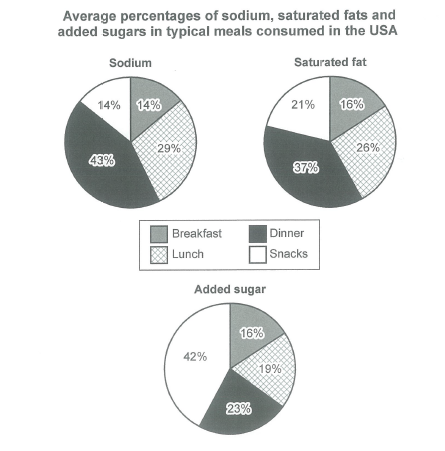
The charts below show the average percentages in typical meals of three types of nutrients, all of which may be unhealthy if eaten too much.
Summarize the information by selecting and reporting the main features, and make comparisons where relevant.
Student answer (Band 5.5)
The chart illustrates the percentages of different typical meals and the three types of nutrients that may be harmful to health if used in excess.
In the USA, people consumed typical meals with sodium, saturated fats, and added sugars. Sodium was consumed in 43% of dinners. 14% each in breakfast and snacks, and 29% in lunch. However, saturated fat was consumed in 37% of dinners and 21% of snacks, 16% of breakfast, and 26% of lunch. Therefore, added sugar was used in 42% of snacks, 16% of breakfast,19% of lunch and 23% of dinner.
People consumed sodium and saturated fat in dinners more than added sugar, on the other hand, they used added sugar more than others in snacks.
AI examiner evaluation
| Criterion | Band |
|---|---|
| Task Achievement / Task Response | 5.0 |
| Coherence and Cohesion | 6.0 |
| Lexical Resource | 6.0 |
| Grammatical Range and Accuracy | 5.5 |
| Overall | 5.5 |
Task Achievement / Task Response: Band 5.0
You report all twelve figures accurately and identify the main contrast: dinner has the highest shares of sodium and saturated fat, while snacks have the highest share of added sugar. However, the response is only a partial summary because it lacks a clear, separate overview of the key patterns and gives little interpretation beyond listing values. The opening sentence describes the chart generally rather than summarising its main message, and the final comparison is brief. The response also contains 119 words, below the required minimum of 150, which limits how fully you can select and explain the most important features. Add an overview and develop comparisons, for example by noting that breakfast is the lowest or joint-lowest meal for all three nutrients.
Coherence and Cohesion: Band 6.0
The information is arranged in a generally understandable order: the introduction is followed by figures for sodium, saturated fat and added sugar, then a concluding comparison. This gives the reader a basic progression, and the nutrient-by-nutrient grouping is appropriate. Cohesion is less effective in places, however. “Therefore” does not clearly express the relationship between the saturated-fat figures and the added-sugar figures, while “However” introduces a contrast that is not fully explained. The final sentence also joins two contrasting ideas with a comma, making the relationship less clear. Use more precise links such as “By contrast” and “Overall,” and separate the overview from the detailed figures to make the structure easier to follow.
Lexical Resource: Band 6.0
Your vocabulary is adequate for describing the chart, and terms such as “percentages,” “saturated fats,” “added sugars” and “consumed” communicate the subject clearly. You also attempt some variation with “harmful to health if used in excess.” However, several choices are imprecise or repetitive: “different typical meals” suggests the meals themselves are being measured, and “used” is not a natural way to describe nutrient proportions in meals. Repeating “consumed” also makes the account less flexible. Aim for accurate chart language such as “accounted for,” “share” and “proportion,” while keeping the wording concise. These improvements would make comparisons sound more natural and precise without requiring unnecessarily complex vocabulary.
Grammatical Range and Accuracy: Band 5.5
You use mostly straightforward sentence patterns, and the figures are generally presented in a way that readers can understand. There is an attempt at a more complex contrast in the final sentence, but its clauses are joined with a comma rather than correctly punctuated, and the sentence would be clearer if divided or linked with a conjunction. The fragment “14% each in breakfast and snacks, and 29% in lunch” is not a complete sentence because it lacks a verb. There is also a missing space after the comma in “breakfast,19%.” These errors do not prevent understanding, but they show that sentence boundaries and punctuation need more control. Practise combining complete clauses accurately and vary the sentence structures used to report comparisons.
See this exact question answered at other band scores. The same prompt compared across bands.
Browse more IELTS Writing model answers or get your own writing scored by the same AI examiner.