Band 5.0 IELTS Writing Task 1 Model Answer
Overall Band Score: 5.0 · Cambridge IELTS 14 · 2026-11-15
IELTS Writing Task 1 question
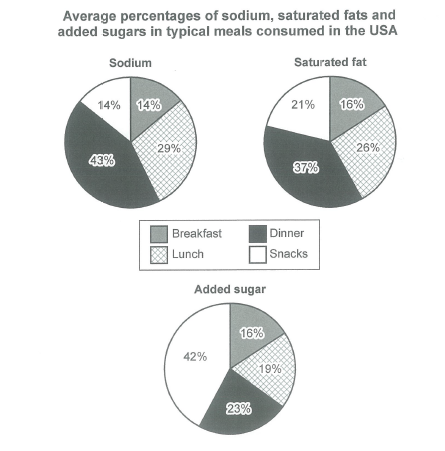
The charts below show the average percentages in typical meals of three types of nutrients, all of which may be unhealthy if eaten too much.
Summarize the information by selecting and reporting the main features, and make comparisons where relevant.
Student answer (Band 5.0)
So all these pie charts tell us that how may percent of sodium,saturated fat and sagar is present in breakfast,dinner,lunch and in the snacks of an average person that lived in USA typically consumed in these meals.first if we see in berakfast the amount of sodium is 14 percent and saturated fat is 16 percent in the case of sugar it is also 16 percent. if we pick out lunch the whole senerio changes the sodium amount ia at 29 percent and saturated fat is at 26 percent but the amount of sugar is 19 percent . But in dinner the amount of sodium is 43 percent it is very high and bad for health also the saturated fat amount is very high and bad for health but if we see sugar amount it is at 23 percent.But if we see snacks portion the sugar amount is very high its amount is 42 percent
AI examiner evaluation
| Criterion | Band |
|---|---|
| Task Achievement / Task Response | 5.0 |
| Coherence and Cohesion | 5.0 |
| Lexical Resource | 5.0 |
| Grammatical Range and Accuracy | 5.0 |
| Overall | 5.0 |
Task Achievement / Task Response: Band 5.0
You identify the three nutrients and report several figures accurately, including breakfast sodium and fat, lunch values, dinner sodium, and the high added-sugar share in snacks. However, the summary is only partial: there is no clear overview of the main patterns, and the saturated-fat figures for dinner and snacks are not reported. The statement that dinner’s saturated fat is “very high” is not supported with its value, while the health comment adds interpretation rather than summarising the chart. To strengthen the response, give an overview first—for example, dinner has the highest sodium and saturated fat, whereas snacks have the highest added sugar—and then compare the key figures across all meals.
Coherence and Cohesion: Band 5.0
The response follows a basic meal-by-meal order, and transitions such as “if we pick out lunch” and “But in dinner” help signal movement between categories. However, the writing is presented as one continuous block, with no distinct overview or paragraphing to guide the reader. Repeated openings such as “if we see” and “the amount” make the progression feel mechanical, and the long opening sentence is difficult to follow. Some links between ideas are also unclear, particularly where the discussion shifts from dinner to snacks. Organise the response into an introduction, an overview, and one or two detail paragraphs, using concise comparisons rather than repeating the same transition.
Lexical Resource: Band 5.0
You use relevant basic terms such as “sodium,” “saturated fat,” “breakfast,” and “percent,” so the chart’s subject is generally understandable. However, the vocabulary range is limited and several noticeable spelling and word-choice errors reduce clarity, including “sagar,” “berakfast,” “senerio,” and “ia.” Phrases such as “the whole senerio changes” and “very high and bad for health” are imprecise or informal for an academic report. Aim for accurate chart language and neutral descriptions: use “proportion” or “share,” and describe a figure as “the highest” rather than making a health judgement. Proofreading spelling and choosing more precise collocations would make the information easier to interpret.
Grammatical Range and Accuracy: Band 5.0
The response attempts some longer sentences and uses basic linking words, but sentence structures are limited and longer constructions are often faulty. For example, the opening, “So all these pie charts tell us that how may percent … is present,” has an incorrect embedded question structure and unclear agreement. Several sentences run together without appropriate full stops, and punctuation around clauses is inconsistent. The repeated pattern “if we see … the amount … is” also limits grammatical variety. Practise writing shorter, complete sentences with a clear subject and verb, then add controlled comparisons using forms such as “Dinner accounts for 43% of sodium, compared with 29% at lunch.” Careful sentence boundaries and accurate clause structure are the main priorities.
See this exact question answered at other band scores. The same prompt compared across bands.
Browse more IELTS Writing model answers or get your own writing scored by the same AI examiner.