Band 5.5 IELTS Writing Task 1 Model Answer
Overall Band Score: 5.5 · Cambridge IELTS 14 · 2026-11-15
IELTS Writing Task 1 question
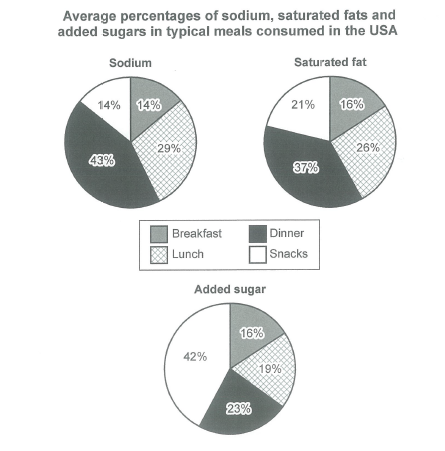
The charts below show the average percentages in typical meals of three types of nutrients, all of which may be unhealthy if eaten too much.
Summarize the information by selecting and reporting the main features, and make comparisons where relevant.
Student answer (Band 5.5)
The pie charts illustrate the proportaion of sodium, saturated fat, and added suger in traditional meals, though these can be harmful if people consume more than the demand.
Overall, sodium and saturated fat are highly consumed during dinner time comared to other meal times, whereas added sugar intake is relatively significant in the snacks period. Meanwhile, sodium, saturaed fat and added sugar consumption has less difference in breaffast and lunch time.
During dinner, people generally take more sodium and saturated fat in thier meals, with 43% and 37% respectively, whereas, only 23% of added sugar are consumed. Simmilarly, tendancy of eating sodium and saturated fat in lunch falls after dinner, which is 29% and 26% respectively. In the snacks break, people take more sodium which is 14% and take less of
AI examiner evaluation
| Criterion | Band |
|---|---|
| Task Achievement / Task Response | 5.0 |
| Coherence and Cohesion | 5.5 |
| Lexical Resource | 5.5 |
| Grammatical Range and Accuracy | 5.5 |
| Overall | 5.5 |
Task Achievement / Task Response: Band 5.0
You identify the main contrast: dinner has the highest shares of sodium and saturated fat, while snacks lead for added sugar. The figures you give for dinner and lunch are accurate, and the response is organised around relevant meal comparisons. However, the report is incomplete: it ends mid-sentence (“take less of”), so the snack figures and the important breakfast pattern are not fully reported. The claim that breakfast and lunch show “less difference” is also unclear and not supported with a precise comparison. The response contains 131 words, below the required 150, which contributes to the limited coverage. To strengthen the report, complete the comparisons and include a concise overview of the main highs and lows across all four meals.
Coherence and Cohesion: Band 5.5
There is a recognisable structure, with an introduction, an overview and a paragraph giving figures for dinner and lunch. Linking expressions such as “Overall,” “whereas” and “Similarly” help signal comparisons. However, progression is interrupted because the final sentence stops at “take less of,” leaving the snack discussion unfinished and the report without a complete ending. The overview’s statement about breakfast and lunch is difficult to follow, and “Meanwhile” does not clearly connect that point to the preceding contrast. For clearer cohesion, group the data systematically—for example, describe the meal with the highest values, then contrast it with the other meals—and ensure each sentence is complete and each reference is clear.
Lexical Resource: Band 5.5
You use some relevant chart-reporting vocabulary, including “proportion,” “consumed,” “respectively” and “compared to,” and the reader can generally understand the intended comparisons. However, the range is limited and several spelling errors are noticeable, including “proportaion,” “suger,” “comared,” “saturaed” and “breaffast.” Some expressions are also unnatural for describing chart data: “highly consumed during dinner time” and “snacks period” would be more precise as “account for a larger share at dinner” and “in snacks.” “More than the demand” does not clearly express the idea of excessive consumption. Use accurate spellings and standard data-reporting collocations, such as “percentage,” “share” and “account for,” to make the description more precise and natural.
Grammatical Range and Accuracy: Band 5.5
The response attempts a mixture of simple statements and longer comparative sentences, such as “Overall, sodium and saturated fat are highly consumed during dinner time … whereas added sugar intake is relatively significant in the snacks period.” This shows some ability to connect ideas, but control is uneven. In “sodium, saturaed fat and added sugar consumption has less difference,” the subject and verb do not agree, and the construction itself is unclear. “Only 23% of added sugar are consumed” also has a number-agreement problem; a percentage of a substance would normally take “is,” or the sentence could refer to “people.” The final sentence is incomplete, and punctuation around “whereas” is awkward. Practise accurate agreement and complete sentence structures while retaining the comparative forms you attempt.
See this exact question answered at other band scores. The same prompt compared across bands.
Browse more IELTS Writing model answers or get your own writing scored by the same AI examiner.