Band 5.0 IELTS Writing Task 1 Model Answer
Overall Band Score: 5.0 · Cambridge IELTS 14 · 2026-11-15
IELTS Writing Task 1 question
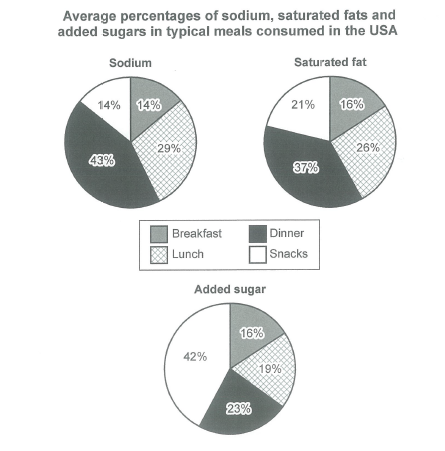
The charts below show the average percentages in typical meals of three types of nutrients, all of which may be unhealthy if eaten too much.
Summarize the information by selecting and reporting the main features, and make comparisons where relevant.
Student answer (Band 5.0)
The pie chart compares the information the percentage in particular mreals of three type of nutrients if eaten to much then may be harmful for our life.
Overall, it is clear that Dinner had recoded the highest percentage in three diffrenr meal USA entire the frame. While, snaks was increase among three meals. others were same percentage.
In Sodium and Saturated fat the porporatio of the earting meals were increase but sodium eatnig meals was increase as compared to saturated fat at 43% and 37%. Furtermore, Average percentage of sodium in breakfast and snacks were same in the usa. when snacks waas increase from 14% to 21%. Breakfast may also increased from 14% to 16% typical meals conassumed in usa. In contrast, lunch were decrease percentage 29% to 26% meals consumed in the usa.
However, snackas was half of the added sugar 42% and breakfas were same added sugar and saturated fat. at 16% popularity eating meals in usa. Consequentally, lunch and dinner which percentage of eating meals in usa 4 point declined 19% adn 23%.
AI examiner evaluation
| Criterion | Band |
|---|---|
| Task Achievement / Task Response | 5.5 |
| Coherence and Cohesion | 5.0 |
| Lexical Resource | 4.5 |
| Grammatical Range and Accuracy | 5.0 |
| Overall | 5.0 |
Task Achievement / Task Response: Band 5.5
You identify the main broad pattern that dinner has the highest share for sodium and saturated fat, and you include several relevant figures, such as 43% and 37%. You also note that snacks account for the largest proportion of added sugar. However, the overview is unclear and partly inaccurate: snacks do not increase across the meal categories, but have the same sodium share as breakfast and the highest added-sugar share. Some comparisons are also misreported or difficult to interpret, including “lunch and dinner … 4 point declined”; the figures are 19% and 23%, with dinner higher. The response covers the charts but does not consistently select and explain the key comparisons. A clearer overview and accurate, direct comparisons would strengthen the report.
Coherence and Cohesion: Band 5.0
The response has an introduction, an attempted overview and further discussion, so there is some basic organisation. It also uses linking expressions such as “Overall,” “Furthermore” and “In contrast.” However, the progression is difficult to follow because the discussion moves between nutrients and meals without a consistent structure. For example, the paragraph beginning “In Sodium and Saturated fat” shifts from comparing those nutrients to breakfast, snacks and lunch, while the final sentences return to added sugar without a clear transition. Several connectors do not show the intended relationship clearly, and references such as “others” are vague. Organise the details by nutrient or by meal, and use simpler, more precise links between comparisons.
Lexical Resource: Band 4.5
You attempt some task-relevant vocabulary, including “percentage,” “proportion” and “consumed,” and use terms for the three nutrients. However, spelling errors and inaccurate or unnatural word combinations frequently make the meaning harder to understand: examples include “mreals,” “porporatio,” “earting meals” and “snaks.” Phrases such as “snacks was half of the added sugar” and “Dinner had recoded the highest percentage” do not express the data naturally or precisely. The vocabulary range is limited, and repeated use of “percentage” and “meals” does not always distinguish a nutrient’s share from the meal itself. Build a reliable set of chart-reporting phrases and check spelling and collocations before submitting.
Grammatical Range and Accuracy: Band 5.0
You attempt both simple and more complex sentences, including a contrast introduced by “In contrast,” but control is inconsistent. Errors in sentence structure and verb forms often obscure comparisons, as in “snaks was increase” and “lunch were decrease percentage.” Articles, plurals and agreement are also unreliable, while some clauses lack a clear grammatical connection to the preceding words. The opening sentence, for instance, does not form a clear, complete description of what the chart compares. Punctuation and spacing are uneven, which adds to the difficulty of reading. Practise writing short, complete comparison sentences first, using patterns such as “Dinner accounted for 43% of sodium,” then combine them with accurate contrast clauses.
See this exact question answered at other band scores. The same prompt compared across bands.
Browse more IELTS Writing model answers or get your own writing scored by the same AI examiner.