Band 5.0 IELTS Writing Task 1 Model Answer
Overall Band Score: 5.0 · Cambridge IELTS 14 · 2026-11-16
IELTS Writing Task 1 question
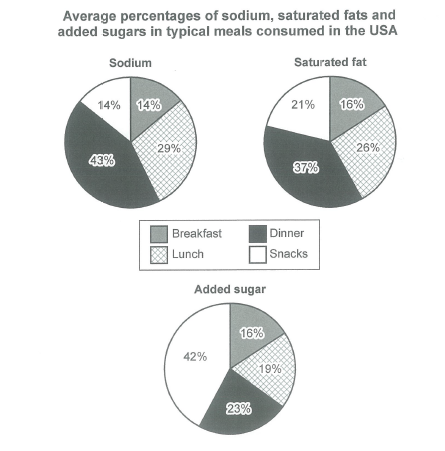
The charts below show the average percentages in typical meals of three types of nutrients, all of which may be unhealthy if eaten too much.
Summarize the information by selecting and reporting the main features, and make comparisons where relevant.
Student answer (Band 5.0)
The bar charts illustrates the moderate percentages in three kinds of meals which have different nutrients, if they consumed so much cause hazardous effects on body.
Overall, graph shows ordinary percentages of sodium , saturated fats, and added sugars in typical meals consumed in usa. The concentration of sodium and saturated fat are in higher content in dinner while, sodium percetages is slightly greater in dinner. The added sugars is mostly high in snacks as compared to other eating times like breakfast , dinner and lunch.
The soduim concentration in snaks and breakfast is half of quarter as compared to saturated fat in snacks and breakfast while, the percent of sodium and saturated fat is same in lunch meal in contrast , number of added sugar is slightly less in dinner meals while their percentages is higher in snacks which is 42 percent
AI examiner evaluation
| Criterion | Band |
|---|---|
| Task Achievement / Task Response | 5.0 |
| Coherence and Cohesion | 5.0 |
| Lexical Resource | 5.0 |
| Grammatical Range and Accuracy | 5.0 |
| Overall | 5.0 |
Task Achievement / Task Response: Band 5.0
You identify the main pattern that sodium and saturated fat peak at dinner, while added sugar is highest in snacks. However, the report is only partial: it gives no precise figures for most categories and includes an unclear comparison, “sodium concentration in snaks and breakfast is half of quarter,” which does not accurately describe the data. Sodium is 14% at both breakfast and snacks, while saturated fat is 16% and 21% respectively; the two nutrients are not equal at lunch either (29% versus 26%). The overview also says sodium is “slightly greater in dinner,” without making clear what it is being compared with. The response is 143 words, below the required 150. Include a clear overview and select several accurate figures to support the comparisons.
Coherence and Cohesion: Band 5.0
There is some organisation: the response begins with an introduction, follows with an overview, and then attempts to compare individual meal categories. This gives the reader a basic sense of the report’s purpose. However, progression is limited because the final paragraph combines several comparisons in one long, difficult-to-follow sentence. Connectors such as “while” and “in contrast” are used, but the relationships they signal are sometimes unclear or inaccurate. For example, the sentence about sodium and saturated fat at lunch shifts abruptly to added sugar at dinner and snacks. Separate the data into clearer comparison groups, use one main point per sentence, and ensure each linking phrase expresses the intended relationship.
Lexical Resource: Band 5.0
You use relevant topic vocabulary, including “sodium,” “saturated fats,” “added sugars,” “percentages,” and “typical meals,” so the subject is generally recognisable. However, the range is limited and several word choices or collocations make the meaning difficult to follow. “Moderate percentages” and “ordinary percentages” do not describe the chart precisely, while “concentration” is not the most suitable term for these proportions. There are also noticeable spelling errors, including “soduim,” “snaks,” and “percetages.” Use standard chart-reporting language such as “accounted for,” “proportion,” and “was highest,” and check spelling carefully. More precise vocabulary would help you express comparisons without relying on vague phrases.
Grammatical Range and Accuracy: Band 5.0
The response attempts some longer sentences and uses comparison structures, but the range is limited and complex sentences are often faulty. The opening, “The bar charts illustrates,” has a subject–verb agreement error, and “if they consumed so much cause hazardous effects” lacks a clear grammatical structure. In the overview, “The added sugars is mostly high” also has agreement problems. Punctuation and sentence boundaries are inconsistent, particularly in the final paragraph, where several clauses are joined with commas and “while” without clear control. These errors sometimes make the intended comparisons hard to understand. Practise accurate simple sentences first, then build longer comparisons with clearly structured clauses and consistent subject–verb agreement.
See this exact question answered at other band scores. The same prompt compared across bands.
Browse more IELTS Writing model answers or get your own writing scored by the same AI examiner.