Band 5.5 IELTS Writing Task 1 Model Answer
Overall Band Score: 5.5 · Cambridge IELTS 14 · 2026-11-16
IELTS Writing Task 1 question
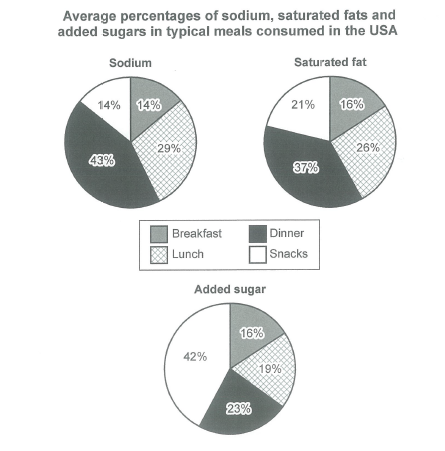
The charts below show the average percentages in typical meals of three types of nutrients, all of which may be unhealthy if eaten too much.
Summarize the information by selecting and reporting the main features, and make comparisons where relevant.
Student answer (Band 5.5)
The pie charts show the average consumption of sodium, saturated fat , and added sugar in four types of meal in the USA
Overall, People in USA consumed most of their sodium and saturated fat in dinner in contrast to consumption of sugar that happened mostly in snacks time.
Both sodium and saturated fat were taken in large amount in the dinner time with proportion of 43% and 37%. People consumed sodium 14% in snacks and breakfast whereas in case of saturated fat people consumed slightly more than that. However, people consumed 29% and 26% of sodium and saturated fat in lunch respectively.
People took large amount of added sugar in dinner time with the share of 42%. Their lowest amount of consumption is 16% in the breakfast. the consumption rose by 3% and became 19% in the lunch and it continued to increase and became 23% in the dinner.
AI examiner evaluation
| Criterion | Band |
|---|---|
| Task Achievement / Task Response | 5.0 |
| Coherence and Cohesion | 5.5 |
| Lexical Resource | 5.5 |
| Grammatical Range and Accuracy | 5.5 |
| Overall | 5.5 |
Task Achievement / Task Response: Band 5.0
You identify the main contrast accurately: dinner has the largest shares of sodium and saturated fat, while snacks account for the most added sugar. Several figures are also reported correctly, including dinner’s 43% sodium and 37% saturated fat, and the 16% breakfast share for sugar. However, the coverage is partial and some key information is missing or misreported. Most importantly, you say added sugar is highest at dinner, then give 42%; in fact, 42% is the snacks figure, while dinner is 23%. The response also omits the snacks share of saturated fat and does not clearly compare all four meal types across the nutrients. A more complete overview and accurate reporting of the sugar pattern would strengthen the summary.
Coherence and Cohesion: Band 5.5
The response has a recognisable structure, moving from an introduction and overview to details about sodium, saturated fat and sugar. This gives the reader a basic route through the information, and words such as “whereas” and “however” help signal comparisons. However, progression is not fully clear: the final paragraph first claims sugar peaks at dinner, then describes a rise from breakfast through lunch to dinner, without resolving the contradiction with the chart’s 42% snacks figure. Some links are also repetitive, particularly the repeated use of “consumed” and “people.” Grouping the figures more systematically—for example, contrasting dinner’s high sodium and fat with snacks’ high sugar—would make the comparisons easier to follow and improve cohesion.
Lexical Resource: Band 5.5
You use enough topic vocabulary to communicate the general subject, including “proportion,” “share,” “consumption” and the nutrient names. There is some attempt to vary expression, as in “in contrast to” and “continued to increase.” However, the range is limited and several phrases are awkward or imprecise for describing chart data, such as “in snacks time,” “taken in large amount” and “consumption of sugar that happened mostly.” Repetition of “people consumed” also reduces flexibility. Aim for concise, conventional chart language and use terms such as “accounted for,” “the largest proportion” and “the figure for snacks.” This would make the description more precise and natural without requiring unnecessarily complex vocabulary.
Grammatical Range and Accuracy: Band 5.5
You produce several understandable simple and compound sentences, and the comparison structure in “whereas in case of saturated fat…” shows an attempt to use more than basic sentence patterns. However, control is uneven, with recurring errors in articles, agreement, punctuation and sentence boundaries. For example, “in large amount” needs a plural form and an article, while “Their lowest amount of consumption is 16%” shifts awkwardly into the present tense and uses an unclear pronoun. Capitalisation after sentence breaks is inconsistent, as in “the consumption rose,” and commas are missing in places where clauses are joined. These issues do not prevent the main meaning from being understood, but more accurate sentence construction and consistent tense would improve clarity.
See this exact question answered at other band scores. The same prompt compared across bands.
Browse more IELTS Writing model answers or get your own writing scored by the same AI examiner.