Band 5.0 IELTS Writing Task 1 Model Answer
Overall Band Score: 5.0 · Cambridge IELTS 14 · 2026-11-16
IELTS Writing Task 1 question
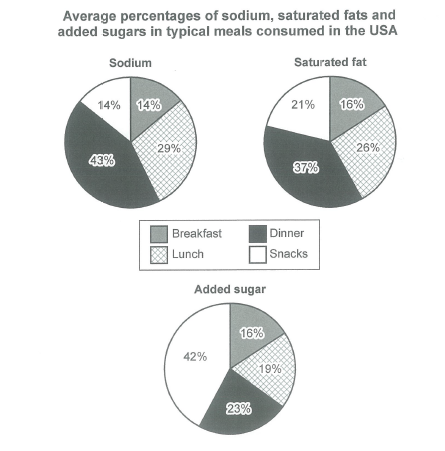
The charts below show the average percentages in typical meals of three types of nutrients, all of which may be unhealthy if eaten too much.
Summarize the information by selecting and reporting the main features, and make comparisons where relevant.
Student answer (Band 5.0)
The charts illustrate that, the percentages of three types nutrients; sodium, saturated fat and sugar that people consume through their daily meals. Over eat them can be harmful for consumers.
Overall, it is seen that people usually eat a large amount nutritive elements in lunch and dinner. They also have significant number of nutrients through breakfast and snacks.
People take sodium and saturated fat in dinner; the percentages is 43% and 37% respectively. While people take sugar more that one third percent by snacks.
AI examiner evaluation
| Criterion | Band |
|---|---|
| Task Achievement / Task Response | 4.0 |
| Coherence and Cohesion | 5.5 |
| Lexical Resource | 5.0 |
| Grammatical Range and Accuracy | 5.0 |
| Overall | 5.0 |
Task Achievement / Task Response: Band 4.0
You identify the three nutrients and report two important peaks accurately: sodium and saturated fat are highest at dinner, at 43% and 37%, while added sugar is highest in snacks. However, the response covers only a small part of the chart. It gives no comparisons across the remaining meal categories and does not report the other key figures, so the overview that lunch and dinner contain “a large amount” is too broad and partly misleading: snacks have the highest added-sugar share. The task’s 150-word minimum is also not met; at 84 words, the response is substantially short, which limits the detail and comparisons you can provide. Include a fuller overview and select figures that show the contrasting patterns.
Coherence and Cohesion: Band 5.5
The response has a recognisable sequence: an introduction, an overview, and then a sentence with specific figures. This basic paragraphing helps the reader follow the intended structure. However, the progression is very brief and the comparisons are not developed into a connected account of all three nutrients. The opening sentence’s punctuation interrupts the flow, and “While” begins a fragment rather than a complete contrast. The overview and final sentence also sit beside one another without clearly explaining how the snack figure contrasts with the dinner figures. Use complete sentences and organise the body around the main patterns—for example, dinner’s high sodium and saturated fat shares versus snacks’ high added sugar.
Lexical Resource: Band 5.0
You use relevant topic vocabulary, including “percentages,” “sodium,” “saturated fat,” “dinner,” and “snacks,” so the subject is generally clear. However, the range is limited, and several word choices or combinations are unnatural: “three types nutrients,” “Over eat them,” “large amount nutritive elements,” and “significant number of nutrients.” These expressions make parts of the description difficult to interpret precisely. “Sugar” is also less specific than the chart’s label, “added sugar.” Build a small set of accurate chart-description phrases, such as “the proportion of added sugar,” “accounted for,” and “was highest in,” and use them consistently. This would make the limited range more precise and appropriate to an academic report.
Grammatical Range and Accuracy: Band 5.0
You attempt more than one sentence pattern, including an overview and a contrast introduced with “While,” but control is inconsistent. The opening has faulty punctuation and sentence construction: “The charts illustrate that, the percentages…” does not form a correct clause. In “people usually eat a large amount…,” the article and noun agreement are problematic, while “the percentages is” has a subject–verb agreement error. The final “While” clause is incomplete, and “people take” is repeated without a clear grammatical link between the two ideas. These errors sometimes make the intended relationships unclear. Practise accurate simple comparison sentences first, then combine them with clauses such as “whereas” or “while,” ensuring each sentence has a complete main clause and correct agreement.
See this exact question answered at other band scores. The same prompt compared across bands.
Browse more IELTS Writing model answers or get your own writing scored by the same AI examiner.