Band 6.5 IELTS Writing Task 1 Model Answer
Overall Band Score: 6.5 · Cambridge IELTS 14 · 2026-11-16
IELTS Writing Task 1 question
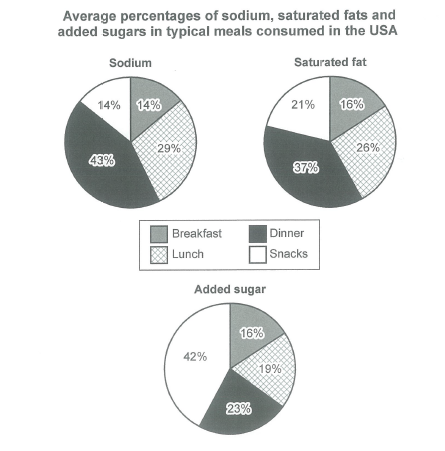
The charts below show the average percentages in typical meals of three types of nutrients, all of which may be unhealthy if eaten too much.
Summarize the information by selecting and reporting the main features, and make comparisons where relevant.
Student answer (Band 6.5)
The pie chart illustrates the percentage of three types of nutrients, which can be unhealthy if consumed in large quantities.
Overall, it is clear that dinner had the highest proportion of sodium and saturated fat, while snacks were the highest in added sugar. In contrast, breakfast had the lowest percentage of all three nutrients.
Regarding the sodium, dinner accounted for the highest percentage at 43%, followed by lunch at 29%. While breakfast and snacks had the lower and same percentage at just 14%. Furthermore, saturated fat, Dinner reported higher percentage at 37%, compared with lunch at 26%. Snacks had the 21% and breakfast had the lowest percentage at 16%.
In terms of added sugar, snacks had the highest percentage at 42%, followed by dinner at 23%. Lunch reported 19% and breakfast had 16%. In summary, dinner had the highest proportion of sodium and saturated fat, whereas in added sugar snacks had the highest percentage.
AI examiner evaluation
| Criterion | Band |
|---|---|
| Task Achievement / Task Response | 7.5 |
| Coherence and Cohesion | 7.0 |
| Lexical Resource | 6.0 |
| Grammatical Range and Accuracy | 6.0 |
| Overall | 6.5 |
Task Achievement / Task Response: Band 7.5
The response selects the main features accurately: dinner is highest for sodium (43%) and saturated fat (37%), while snacks lead for added sugar (42%); breakfast is lowest for all three, with sodium tied at 14% with snacks. The overview is clear and the body supports it with relevant figures, so the key comparisons are well covered. To make the account more fully developed, compare the nutrients across meal types more explicitly—for example, note that dinner’s sodium share is substantially higher than its saturated-fat share, while snacks show the reverse pattern for added sugar. The final sentence repeats the overview rather than adding a further comparison, and the opening could identify the USA context shown in the chart.
Coherence and Cohesion: Band 7.0
The response has a clear progression from introduction to overview, then separate discussion of sodium and saturated fat, followed by added sugar. This makes the information easy to follow, and signposts such as “Overall,” “Regarding,” and “In terms of” help distinguish the sections. Cohesion is generally effective, though some linking is mechanical and the conclusion repeats the overview almost verbatim. The sentence beginning “While breakfast and snacks…” is also a fragment, which interrupts the flow between the sodium comparisons. For a more polished progression, combine that point with the preceding sentence and use the final paragraph to make a concise cross-category comparison rather than restating the same summary.
Lexical Resource: Band 6.0
The vocabulary is adequate for describing chart data, with useful terms such as “proportion,” “accounted for,” and “followed by.” The writer also varies the wording for reporting figures, which keeps the response understandable. However, some choices are repetitive or imprecise: “percentage” and “highest” recur frequently, and “reported higher percentage” is not a natural collocation for a chart. “The lower and same percentage” is also awkward and makes the comparison less precise. Greater control of common data-description collocations and a few alternatives for ranking and comparison would improve flexibility. The meaning remains clear throughout, but the range is not yet consistently precise or natural.
Grammatical Range and Accuracy: Band 6.0
The response uses a mix of simple statements and more complex forms, including the contrast in “while snacks were the highest in added sugar” and the comparison “compared with lunch at 26%.” Most information is readily understood, but some grammatical errors remain. “While breakfast and snacks had the lower and same percentage at just 14%” is a fragment and has an unclear structure; it should be joined to the preceding sentence. In “Dinner reported higher percentage,” the article is missing, and “Snacks had the 21%” uses an unnecessary article. Capitalisation is also inconsistent in “Dinner” within a sentence. Aim to produce complete sentences and check articles and sentence boundaries while retaining the range of structures already attempted.
See this exact question answered at other band scores. The same prompt compared across bands.
Browse more IELTS Writing model answers or get your own writing scored by the same AI examiner.