Band 5.5 IELTS Writing Task 1 Model Answer
Overall Band Score: 5.5 · Cambridge IELTS 14 · 2026-11-16
IELTS Writing Task 1 question
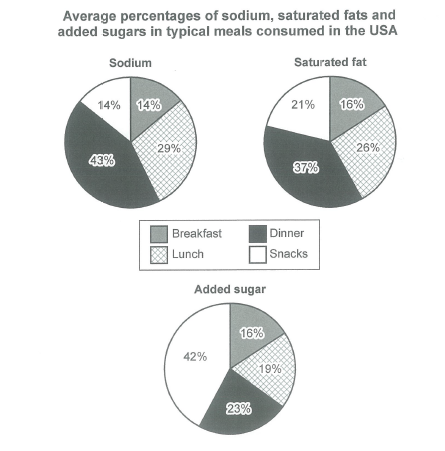
The charts below show the average percentages in typical meals of three types of nutrients, all of which may be unhealthy if eaten too much.
Summarize the information by selecting and reporting the main features, and make comparisons where relevant.
Student answer (Band 5.5)
The bar charts illustratre the average proportion in different foods of sodium,saturated fat and added sugar if its eaten too much may be not good for health.
Overall,in breakfast and lunch sodium consumed equally.While saturated fat in lunch and snacks consumed nearly one fifth.Moreover,added sugar consumed in breakfast and lunch is round about one fifth.
Sodium and saturated fat consumed mostly in dinner sodium consumed nearly half percentage while saturated fat consumed one third.Moreover,in lunch sodium consumed roughly one third while fat consumed in lunch is one fifth.In breakfast sodium consumed 14% while fat consumed 16%. Sodium consumed in snacks is 14% while saturated fat in snacks consumed 21%.
While added sugar consumed in snacks is about 43% which is most than any other.In dinner added sugar consumed 23% which is in second place. In the lunch added sugar consumed 19% which is in third place while in breakfast it consumed 16% which is less than any other.
AI examiner evaluation
| Criterion | Band |
|---|---|
| Task Achievement / Task Response | 5.5 |
| Coherence and Cohesion | 5.5 |
| Lexical Resource | 5.5 |
| Grammatical Range and Accuracy | 5.0 |
| Overall | 5.5 |
Task Achievement / Task Response: Band 5.5
You identify the main pattern that sodium and saturated fat peak at dinner, while added sugar is highest in snacks, and you include several relevant figures. Most reported values are close to the chart, but there are important inaccuracies: breakfast and lunch sodium are not equal (14% versus 29%), and saturated fat in lunch is 26%, not roughly one fifth. The overview also says saturated fat in lunch and snacks is nearly one fifth, although snacks are 21% and lunch is higher. The response therefore covers the charts only partially: it reports many details, but the overview and comparisons do not consistently capture the key differences. Prioritise accurate overall contrasts, then support them with selected figures.
Coherence and Cohesion: Band 5.5
The response has a basic overall structure: an introduction, an overview, and paragraphs describing the nutrient figures. This gives the reader a general route through the information, and contrasts such as dinner versus snacks are relevant. However, progression within the body is not always clear because the discussion shifts repeatedly between nutrients and meals, and several comparisons are repeated. Linking words such as “Moreover” and “While” are used mechanically; the opening “While” in the final paragraph is not connected to a complete preceding contrast. Group the information more deliberately—for example, describe sodium and saturated fat together, then added sugar—and use clear comparison links to show how each figure relates to the others.
Lexical Resource: Band 5.5
You use some task-relevant vocabulary, including “average proportion,” “consumed,” “one third,” and “percentage,” so the reader can identify the subject of the report. However, the range is limited and several word choices or collocations are unnatural or imprecise, especially the repeated phrase “consumed in” and “most than any other.” “Different foods” is also inaccurate because the chart compares meal types, not foods. Spelling errors such as “illustratre” and inconsistent spacing around commas further reduce control. Aim for precise chart language and vary expressions for proportions and comparisons, while checking spelling and standard collocations.
Grammatical Range and Accuracy: Band 5.0
The response attempts some longer structures, including “While saturated fat in lunch and snacks consumed nearly one fifth” and “which is less than any other,” but these are often incomplete or faulty. Many clauses omit a necessary verb or use an incorrect passive pattern: for example, “sodium consumed equally” and “sodium consumed nearly half percentage” need forms such as “accounted for” or “made up.” Articles and sentence boundaries are also inconsistent, as in “in the lunch” and the comma-spliced opening. Most sentences rely on simple repeated patterns, so grammatical control is limited. Practise complete subject–verb clauses and accurate comparison structures before adding more complex sentences.
See this exact question answered at other band scores. The same prompt compared across bands.
Browse more IELTS Writing model answers or get your own writing scored by the same AI examiner.