Band 4.5 IELTS Writing Task 1 Model Answer
Overall Band Score: 4.5 · Cambridge IELTS 14 · 2026-11-16
IELTS Writing Task 1 question
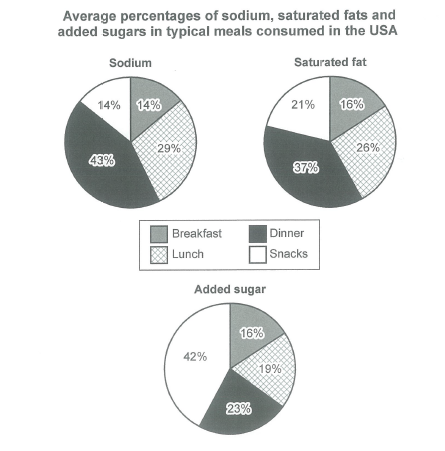
The charts below show the average percentages in typical meals of three types of nutrients, all of which may be unhealthy if eaten too much.
Summarize the information by selecting and reporting the main features, and make comparisons where relevant.
Student answer (Band 4.5)
The charts illustrates the average percentage in typical meals of three kind of neutrients , all of which may be unhealthy if eaten too much.
Overall,it is clear that sodium and saturated fat had largest proportion in dinner but in dinner added suger had declind in lunch the percentage of sodium,saturated fat and added sugar gradually declined however from dinner to breakfast these nutrient figure had rises rapidly.
The pecentage of sodium had highest figure in dinner is 43% while saturated fat percentage in dinner declined is 37% and added sugar pecentage in dinner rapidly decrease is 23%.Similarly in lunch the percentage of sodium had highest figure is 29% in addition saturated fat in lunch gra
AI examiner evaluation
| Criterion | Band |
|---|---|
| Task Achievement / Task Response | 3.5 |
| Coherence and Cohesion | 4.0 |
| Lexical Resource | 5.0 |
| Grammatical Range and Accuracy | 4.5 |
| Overall | 4.5 |
Task Achievement / Task Response: Band 3.5
You identify the chart topic and make a relevant overall comparison: dinner has the highest shares of sodium and saturated fat, while added sugar is highest in snacks. You also report several accurate figures, including dinner’s 43% sodium and 37% saturated fat. However, the response is incomplete and does not cover the key snack figures or provide a clear, accurate comparison across all four meals. The claim that the percentages “gradually declined” in lunch is unclear and does not reflect the full pattern; for example, sodium is higher at lunch than at breakfast. The response contains 106 words, below the required 150, and ends mid-sentence. To improve, complete the summary and select the main contrasts with accurate supporting data.
Coherence and Cohesion: Band 4.0
There is an attempt to organise the response with an opening, an overview beginning “Overall,” and a move to specific figures. Linking expressions such as “while” and “Similarly” also show an effort to connect comparisons. However, the progression is difficult to follow because the overview combines several trends in one long sentence, and the later comparison is unfinished (“saturated fat in lunch gra…”). Some links do not make the relationship between meals and nutrients clear, so the reader has to infer the intended meaning. Use separate, complete paragraphs for the overview and details, and group comparisons by meal or nutrient. Clearer sentence boundaries and explicit contrasts would make the information easier to follow.
Lexical Resource: Band 5.0
You use some task-relevant vocabulary, including “average percentage,” “proportion,” “highest figure,” and “declined,” and you attempt to describe changes and comparisons. However, the range is limited and several word choices or forms make the meaning less precise: “nutrients” is misspelled, “added suger” is unclear, and “had largest proportion” is not a natural way to describe the chart. Repeated use of “percentage” and “figure” also limits variety. Choose precise terms such as “share” or “proportion,” and use comparison language that fits static chart data, such as “accounted for” or “was higher than.” Proofreading spelling and collocations would improve clarity.
Grammatical Range and Accuracy: Band 4.5
The response attempts both simple statements and longer comparative sentences, for example, “Overall, it is clear that…” and “The percentage of sodium had highest figure in dinner is 43%.” However, the longer structures are not controlled, and several sentences contain agreement, article, or verb-form problems. “The charts illustrates” has incorrect subject–verb agreement, while “had highest figure … is 43%” combines incompatible verb patterns. The overview also runs several clauses together without clear punctuation, making the relationships difficult to understand. Aim for complete, shorter sentences first, then add comparisons using accurate structures such as “Dinner accounts for 43% of sodium.” Check articles, agreement, and sentence boundaries when editing.
See this exact question answered at other band scores. The same prompt compared across bands.
Browse more IELTS Writing model answers or get your own writing scored by the same AI examiner.