Band 5.5 IELTS Writing Task 1 Model Answer
Overall Band Score: 5.5 · Cambridge IELTS 14 · 2026-11-17
IELTS Writing Task 1 question
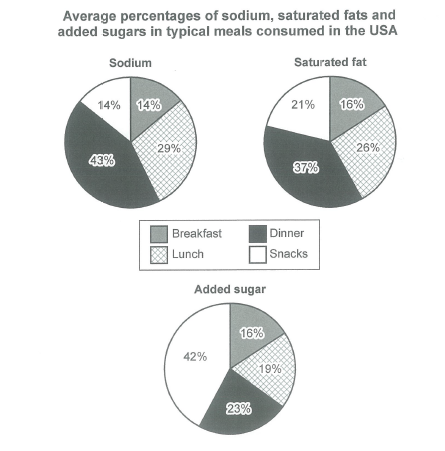
The charts below show the average percentages in typical meals of three types of nutrients, all of which may be unhealthy if eaten too much.
Summarize the information by selecting and reporting the main features, and make comparisons where relevant.
Student answer (Band 5.5)
The diagrams illustrates the average percentages of three types nutrients all of these unhealthy if eaten too much.
Overall, sodium dinner followed up high 43%, while lunch in all of these almost round about equall. Added sugar snacks on the top from other nutrients, although breakfast and snacks is equall in sodium, and other nutrients has same range of breakfast.
Initially, sodium has the highest dinner which is 43%. while that has same percentage of breakfast and snacks. sodium also has the largely number in lunch as compare to other nutrients. Second one is the saturated fat also high in dinner that is 37%, breakfast is 16%, lunch is 26% in saturated fat.
On the other hand, Added sugar is the last one nutrient which has the hight ratio in snacks that is on top as compare to other. breakfast in added sugar is equall to saturated fat that is in both 16%. dinner is less then to others 23% and lunch in this nutrient is 19% that is also less then from all of these.
AI examiner evaluation
| Criterion | Band |
|---|---|
| Task Achievement / Task Response | 5.5 |
| Coherence and Cohesion | 5.5 |
| Lexical Resource | 5.0 |
| Grammatical Range and Accuracy | 5.0 |
| Overall | 5.5 |
Task Achievement / Task Response: Band 5.5
You identify several important features, including dinner as the highest meal for sodium (43%) and saturated fat (37%), and snacks as the main source of added sugar (42%). You also make some relevant comparisons, such as breakfast and snacks having equal sodium shares. However, the overview is difficult to interpret and does not clearly summarise the main contrasts across all three nutrients. The claim that lunch is “almost round about equall” across the nutrients is inaccurate: its shares range from 19% to 29%. Some details are also unclear, such as saying sodium has the “largely number” in lunch without specifying the comparison. State the key patterns clearly, then support them with accurate figures.
Coherence and Cohesion: Band 5.5
The response has a basic paragraph structure: an introduction, an overview, and two paragraphs of detail. This gives the reader some sense of organisation, and phrases such as “On the other hand” attempt to signal a shift to added sugar. However, progression is uneven because the overview is hard to follow and the body paragraphs do not consistently group comparisons by meal or nutrient. Several linking expressions are awkward or unclear, including “Initially” and “Second one,” while repeated references to “other nutrients” make it difficult to identify the comparison. Organise the details more systematically—for example, compare the highest meal for each nutrient, then describe the lower shares—and use clear, accurate transitions.
Lexical Resource: Band 5.0
You use some relevant chart vocabulary, including “average percentages,” “highest,” “same percentage,” and “ratio,” so the topic is generally recognisable. However, the range is limited and several word choices or collocations are inaccurate, which sometimes makes the meaning difficult to understand. Examples include “sodium dinner followed up high,” “the largely number,” and “Added sugar is the last one nutrient.” Repetition of “high,” “same,” and “other” also limits precision. Use standard expressions for describing data, such as “accounted for,” “recorded,” “share,” and “proportion,” and check spelling and word forms, including “equal” and “highest.” More precise vocabulary would make your comparisons clearer.
Grammatical Range and Accuracy: Band 5.0
You attempt both simple and longer sentences, but grammatical errors are frequent and sometimes make relationships between ideas unclear. The opening, “The diagrams illustrates,” has subject–verb disagreement, and “three types nutrients” is missing a necessary preposition. Sentence patterns such as “sodium dinner followed up high 43%” lack a clear grammatical structure, while “breakfast and snacks is equall” has agreement problems. Punctuation also causes difficulty, particularly the full stop before “while” in “43%. while that has same percentage.” Build accurate simple sentences first, such as “Sodium accounts for 43% at dinner,” then practise combining them with clauses using “whereas” or “while.” Check articles, agreement, and sentence boundaries during revision.
See this exact question answered at other band scores. The same prompt compared across bands.
Browse more IELTS Writing model answers or get your own writing scored by the same AI examiner.