Band 5.5 IELTS Writing Task 1 Model Answer
Overall Band Score: 5.5 · Cambridge IELTS 14 · 2026-11-17
IELTS Writing Task 1 question
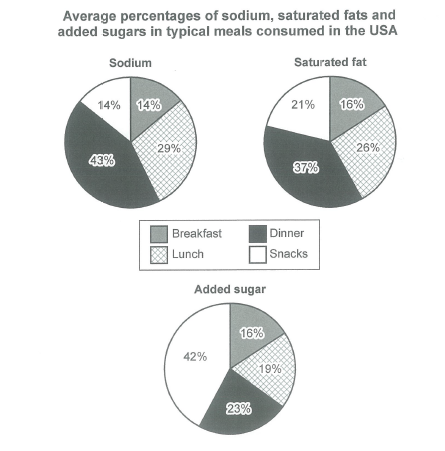
The charts below show the average percentages in typical meals of three types of nutrients, all of which may be unhealthy if eaten too much.
Summarize the information by selecting and reporting the main features, and make comparisons where relevant.
Student answer (Band 5.5)
The pie charts below demonstrate the typical range of three different type of nutrients in the go food, which can be dangerous if exceeds the significant ratio.
Overall, the substantial amount of sodium, and saturated fats are present in our dinner, while snacks have the highest ratio of added sugar.
It is evident that dinner has the highest amount of sodium about 43%, lunch has 29%; meanwhile, the ratio of sodium in snacks, and breakfast mitigate to to 14%. Explicitly the range of saturated fats are significantly higher in dinner nearly 37%, 26% in lunch, 16% in breakfast, and 21% in snacks. The added sugars are mostly used in bakery items and soft drinks for artificial sugary flavours, snacks have approximately 42% of added sugars, 23% in dinner, 19% in lunch, which reduces to 16% in breakfast. The percentage of added sugars have the highest percentage in snacks like choclates, and cakes.
AI examiner evaluation
| Criterion | Band |
|---|---|
| Task Achievement / Task Response | 6.5 |
| Coherence and Cohesion | 5.5 |
| Lexical Resource | 5.5 |
| Grammatical Range and Accuracy | 5.0 |
| Overall | 5.5 |
Task Achievement / Task Response: Band 6.5
You identify the main pattern accurately: dinner has the largest shares of sodium and saturated fat, while snacks lead for added sugar. The figures you report are consistent with the chart, and the opening overview gives the reader a useful summary. This is a strong response to the task, but some details are less fully handled than others. For example, you report all four meal figures for each nutrient, yet the final sentence repeats the snack-sugar point rather than adding a further comparison. The claim that added sugars are mostly used in bakery items and soft drinks is not shown by the charts, so avoid introducing explanations or examples that the visual does not support. A more complete overview could also highlight breakfast’s consistently lowest or joint-lowest shares.
Coherence and Cohesion: Band 5.5
The response has a recognisable overall structure: an introduction, an overview, and details about the three nutrients. This helps the reader follow the main comparisons. However, the body is presented as one long paragraph, and the progression becomes less clear as several figures are packed into a single sentence. Connectors such as “meanwhile” and “Explicitly” are used, but the latter does not clearly signal the relationship between the points, and the repeated final statement about snack sugars weakens the ending. Grouping the figures into two body paragraphs—for example, sodium and saturated fat together, then added sugar—would make the organisation more purposeful. Use linking expressions only where they clarify a contrast or comparison.
Lexical Resource: Band 5.5
You use some relevant task vocabulary, including “percentage,” “sodium,” “saturated fats,” and “added sugars,” and you attempt more formal wording such as “substantial.” However, several choices are inaccurate or unnatural for describing chart data: “typical range” and “go food” do not convey the intended meaning, while “mitigate to” is not suitable for reporting a figure. “The added sugars are mostly used in bakery items and soft drinks” also introduces an unsupported idea and uses imprecise wording. There is a spelling error in “choclates,” and “highest percentage” is repeated. Aim for precise terms such as “share,” “account for,” and “proportion,” and avoid decorative or explanatory vocabulary that does not fit the data.
Grammatical Range and Accuracy: Band 5.0
You attempt a mixture of sentence forms, including a clear overview sentence and longer comparisons using “while” and “meanwhile.” However, control is inconsistent, and errors sometimes make the relationships between figures harder to read. For example, “three different type” has a number-agreement error, and “which can be dangerous if exceeds” is missing a clear subject and a complete conditional structure. The sentence beginning “It is evident that dinner has…” also needs clearer punctuation and sentence boundaries, while “the ratio … mitigate to to 14%” contains faulty verb construction. Practise building accurate comparison sentences with a subject and verb for each clause, and check agreement, articles, and punctuation before combining several figures.
See this exact question answered at other band scores. The same prompt compared across bands.
Browse more IELTS Writing model answers or get your own writing scored by the same AI examiner.