Band 5.5 IELTS Writing Task 1 Model Answer
Overall Band Score: 5.5 · Cambridge IELTS 14 · 2026-11-18
IELTS Writing Task 1 question
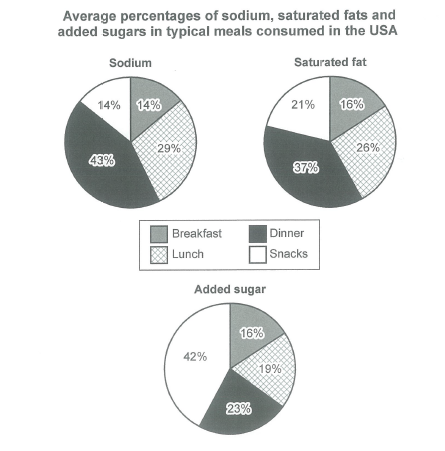
The charts below show the average percentages in typical meals of three types of nutrients, all of which may be unhealthy if eaten too much.
Summarize the information by selecting and reporting the main features, and make comparisons where relevant.
Student answer (Band 5.5)
The pie chart compares the average rates of typical meals of three types of nutrients which is sodium, sarurated fat, added sugar, and it could be unhealthy if eaten too much.
Overall, it is evident that dinner has higher sodium rates than other 2 meals and snacks. Additionally, while dinner has also a greater saturated fat, snacks figures shows the highest added sugar rates, rising dinner but the lowest in sodium.
Looking first at Sodium in the highest one is dinner which is 43% and, to be second one is lunch (29%), so sodium contains greater in dinner. The most low sodium is in lunch and snacks, which the rate indicates a mere 14%. Similarly, dinner rates for saturated fat is significiantly higher, which is 37%, and others are approximate each other.
By contrast, Snacks percentage of added sugar at 42%, while dinner the second highest at 23%. The figure for lunch decreased from 26% to 19%. Meanwhile, breakfast is in all three nutrients are merely from 14% to 16%, which show us it's no major change in meals.
AI examiner evaluation
| Criterion | Band |
|---|---|
| Task Achievement / Task Response | 5.5 |
| Coherence and Cohesion | 5.5 |
| Lexical Resource | 5.0 |
| Grammatical Range and Accuracy | 5.0 |
| Overall | 5.5 |
Task Achievement / Task Response: Band 5.5
You identify the main pattern that dinner accounts for the largest shares of sodium and saturated fat, while snacks lead in added sugar, and you include several relevant figures. However, some data are misreported: sodium is lowest at breakfast and snacks (14%), not lunch and snacks; lunch has 29%. The statement that “the figure for lunch decreased from 26% to 19%” confuses saturated fat and added sugar values, and the comparison is unclear. The overview also says dinner has higher sodium than “other 2 meals and snacks,” overlooking that breakfast and snacks tie. To strengthen the report, check each figure against its meal and nutrient, and summarise the key contrasts accurately before adding details.
Coherence and Cohesion: Band 5.5
The response has a recognisable structure: an introduction, an overview, and paragraphs describing the nutrient figures. This gives the reader some organisation, and transitions such as “Overall,” “Looking first,” and “By contrast” signal changes in focus. However, progression is weakened by unclear or inaccurate links between ideas. For example, “The figure for lunch decreased from 26% to 19%” does not make clear which nutrient values are being compared, while “rising dinner but the lowest in sodium” is difficult to follow. The final sentence combines breakfast figures across all nutrients without a clear connection to the preceding comparison. Grouping each nutrient consistently and using precise references would make the report easier to follow.
Lexical Resource: Band 5.0
You use some relevant chart vocabulary, including “average,” “percentage,” “highest,” and “by contrast,” so the topic is generally understandable. However, the range is limited and several word choices or collocations are inaccurate, such as “average rates of typical meals,” “sodium rates,” and “sodium contains greater in dinner.” These expressions make the data relationships less clear. There are also spelling errors, including “sarurated” and “significiantly,” and “the most low” is not a natural way to describe the smallest figure. Use standard terms such as “proportion,” “accounted for,” and “was highest,” and check spelling and collocations when editing.
Grammatical Range and Accuracy: Band 5.0
You attempt both simple and more complex sentences, including a contrast with “while” and a comparison introduced by “By contrast.” However, control is inconsistent, and faulty sentence structures sometimes make the meaning difficult to follow. For example, “The pie chart compares … which is sodium … and it could be unhealthy” has an unclear relative clause and agreement; “Looking first at Sodium in the highest one is dinner” is not a complete, well-formed construction; and “Meanwhile, breakfast is in all three nutrients are merely from 14% to 16%” contains a faulty clause structure. There are also agreement and article problems, as in “snacks figures shows.” Build shorter, complete sentences first, then add complex clauses with clear subjects and verbs.
See this exact question answered at other band scores. The same prompt compared across bands.
Browse more IELTS Writing model answers or get your own writing scored by the same AI examiner.