Band 5.0 IELTS Writing Task 1 Model Answer
Overall Band Score: 5.0 · Cambridge IELTS 14 · 2026-11-18
IELTS Writing Task 1 question
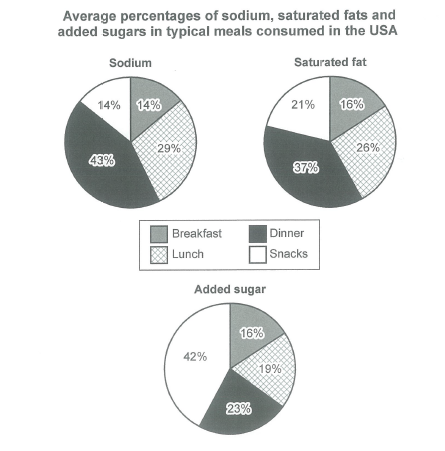
The charts below show the average percentages in typical meals of three types of nutrients, all of which may be unhealthy if eaten too much.
Summarize the information by selecting and reporting the main features, and make comparisons where relevant.
Student answer (Band 5.0)
The chart illutrates the average percentage of the sodium, saturated fat and added sugars in typical meals consumed in the USA. its all is esstinal for health but if we take sufficent amount its benfit for health if we take over amount its make side effect for us.
overall, the sodium and saturated fats are coumsed in the dinner as compared the sugar in dinner . mostly people are used sugar in snacks. morever in the morning the quantity of the its very low as campared in all meals but in the lunch time soduim is 29% and satursated is 26% and sugar is very low as contract both of the its is 19%
as you see in the chart sodium, saturated fats are consumed more its is 43% on sodium and saturated fats is 37% in the diet but mostly in sugar is 23% in dinner but this is not a good diet of us.
AI examiner evaluation
| Criterion | Band |
|---|---|
| Task Achievement / Task Response | 5.5 |
| Coherence and Cohesion | 4.5 |
| Lexical Resource | 4.5 |
| Grammatical Range and Accuracy | 4.5 |
| Overall | 5.0 |
Task Achievement / Task Response: Band 5.5
You identify the chart’s subject and report several relevant figures, including sodium at 43% and saturated fat at 37% for dinner, and added sugar at 42% for snacks. The main contrast—that dinner has the highest sodium and saturated-fat shares while snacks lead for added sugar—is present, but the overview is unclear and some comparisons are inaccurate or incomplete. For example, you say morning quantities are “very low,” although breakfast is not the lowest for every nutrient, and the lunch comparison does not clearly explain that added sugar is 19%. The comment that these meals are “not a good diet” adds an unsupported judgement rather than describing the data. A clearer overview and more precise comparisons across all four meals would make the response more complete.
Coherence and Cohesion: Band 4.5
There is an attempt to organise the response into an introduction, an overview and further details, and linking expressions such as “overall,” “moreover” and “as you see” show an effort to guide the reader. However, the progression is difficult to follow: the overview and the later paragraph repeat dinner comparisons, while several ideas are joined in long, unclear sentences. References such as “the quantity of the its” and “both of the its” make it hard to identify which nutrients are being discussed. Use one paragraph for the main overview and separate paragraphs for comparisons, grouping related figures together. Clear sentence boundaries and more precise referencing would improve the flow.
Lexical Resource: Band 4.5
The response uses some relevant chart vocabulary, including “average percentage,” “consumed,” “sodium,” “saturated fats” and “compared,” so the topic is generally recognisable. However, the range is limited and several spelling and word-choice errors make meaning less clear, such as “illutrates,” “esstinal,” “coumsed” and “soduim.” Phrases such as “take over amount” and “not a good diet of us” are also unnatural for describing chart data. Aim for accurate, neutral reporting language and check spelling carefully. Useful terms include “accounted for,” “proportion,” “highest share” and “lowest figure”; these can help you describe comparisons without adding personal opinions.
Grammatical Range and Accuracy: Band 4.5
You attempt both simple statements and longer sentences, but control of sentence structure is inconsistent, and errors frequently make relationships between ideas difficult to understand. For example, “its all is essential for health but if we take sufficient amount” lacks a clear grammatical structure, while “in the lunch time sodium is 29%” has an awkward sentence pattern. There are also problems with articles, agreement, and sentence boundaries, as in “the quantity of the its very low” and the run-on sequence beginning “as you see in the chart.” Practise writing short, complete comparison sentences first, then combine them with accurate clauses using “while” or “whereas.”
See this exact question answered at other band scores. The same prompt compared across bands.
Browse more IELTS Writing model answers or get your own writing scored by the same AI examiner.