Band 5.5 IELTS Writing Task 1 Model Answer
Overall Band Score: 5.5 · Cambridge IELTS 14 · 2026-11-19
IELTS Writing Task 1 question
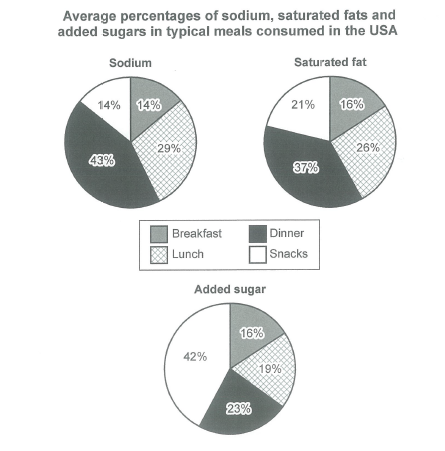
The charts below show the average percentages in typical meals of three types of nutrients, all of which may be unhealthy if eaten too much.
Summarize the information by selecting and reporting the main features, and make comparisons where relevant.
Student answer (Band 5.5)
The pie charts present the average percentages of sodium, saturated fats, and sugar added to different meals in the USA.
Overall, Dinner contains the highest proportion of sodium and saturated fats, while snacks contains the largest of proportion added sugar.
Dinner contains the largest proportion of sodium at around 43%, closely followed by saturated fats and added sugar at roughly 37% and 23%, respectively. In contrast, Snacks contains largest proportion of added sugar at approximately 43%, followed by saturated fats and soduim at roughly 21% and 14% respectively. Meanwhile, lunch contains around 26% pof saturated fats, followed by added sugar at approximately 19%
AI examiner evaluation
| Criterion | Band |
|---|---|
| Task Achievement / Task Response | 5.0 |
| Coherence and Cohesion | 6.0 |
| Lexical Resource | 6.0 |
| Grammatical Range and Accuracy | 5.5 |
| Overall | 5.5 |
Task Achievement / Task Response: Band 5.0
You identify two important overall patterns accurately: dinner has the highest shares of sodium and saturated fat, while snacks lead in added sugar. Several figures are also reported correctly, including dinner’s 43% sodium and 37% saturated fat, and snacks’ 42% added sugar. However, the response covers the charts only partially: breakfast is not discussed, and lunch is mentioned only for two nutrients, with its sodium share omitted. The final comparison is also incomplete, and there is no full account of the main contrasts across all four meals. The response is 47 words below the required minimum, which contributes to the limited development. To improve, include a concise comparison of breakfast and lunch and complete the overview of the key highs and lows.
Coherence and Cohesion: Band 6.0
The response has a clear basic structure: an introduction, an overview, and a paragraph giving selected details. Linking expressions such as “Overall,” “In contrast,” and “Meanwhile” help signal the comparisons, and the information is generally easy to follow. However, the detail paragraph is not fully developed: it moves from dinner to snacks and then lunch, but stops before completing the lunch comparison or addressing breakfast. This makes the progression feel unfinished. Some linking is also repetitive because several figures are presented in a similar “followed by” pattern. Organise the details more systematically—for example, compare the meal with the highest shares against the meal with the lowest, then cover the remaining meals—and ensure each comparison is complete.
Lexical Resource: Band 6.0
You use an adequate range of task-related vocabulary, including “proportion,” “closely followed by,” and “respectively,” which helps describe and compare the data. The meaning is generally clear, but some word-choice and spelling slips reduce precision. “The largest of proportion” is an awkward phrase, and “soduim” is misspelled; “pof” also appears to be a typing error. The chart labels “added sugar” and “saturated fat” would be more accurate than varying these to “sugar added” and “saturated fats.” Continue using comparison language, but prioritise accurate collocations and careful proofreading. More precise terms such as “share” or “accounted for” can also help you avoid repeating “contains.”
Grammatical Range and Accuracy: Band 5.5
You produce several clear simple sentences and attempt more complex comparisons, as in “Dinner contains the largest proportion of sodium at around 43%, closely followed by saturated fats and added sugar…” The overall meaning remains understandable. Some grammatical errors are present, however: “snacks contains” has a subject–verb agreement problem, and “contains largest proportion” is missing an article. The sentence beginning “Meanwhile, lunch contains…” is incomplete as written, ending after a percentage without a finished comparison or punctuation. There is also inconsistent capitalisation of meal names. To improve accuracy, check agreement and articles, and make sure every sentence is complete. A wider range of sentence patterns, used with reliable control, would make the comparisons more fluent.
See this exact question answered at other band scores. The same prompt compared across bands.
Browse more IELTS Writing model answers or get your own writing scored by the same AI examiner.