Band 6.0 IELTS Writing Task 1 Model Answer
Overall Band Score: 6.0 · Cambridge IELTS 14 · 2026-11-19
IELTS Writing Task 1 question
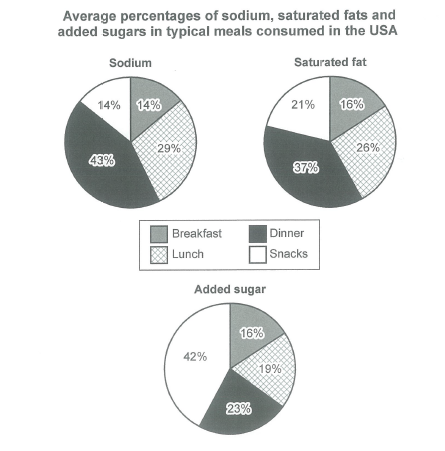
The charts below show the average percentages in typical meals of three types of nutrients, all of which may be unhealthy if eaten too much.
Summarize the information by selecting and reporting the main features, and make comparisons where relevant.
Student answer (Band 6.0)
The diagrams below illustrate the average percentages of three different types of nutrients in typical meals, all of which may be unhealthy if eaten too much.
Overall, three disticnt types of nutrients are demonstrated in the charts. Sodium and saturated fat are used the most in dinner while added sugar has the highest figure in snacks which are followed by the others.
To begin with sodium, it has highly consumed in dinner at the percentage of 43%, followed by lunch at 29% and 14% both in breakfast and snacks. In addition saturated fat has the largest figure in dinner at 37% followed by lunch at 26%, 21% in snacks and the lowest figure is16% in breakfast.
Following this, Added sugar are mostly consumed in snacks at the figure of 42% which is followed by dinner at 23%, 19% in lunch and the final and lowest number is 16% in breakfast.
AI examiner evaluation
| Criterion | Band |
|---|---|
| Task Achievement / Task Response | 6.0 |
| Coherence and Cohesion | 6.0 |
| Lexical Resource | 6.0 |
| Grammatical Range and Accuracy | 5.5 |
| Overall | 6.0 |
Task Achievement / Task Response: Band 6.0
You report the main patterns accurately: dinner has the highest shares of sodium and saturated fat, while snacks lead for added sugar. The figures you give also match the chart, including the equal 14% shares for sodium in breakfast and snacks. However, the overview is brief and the comparison that the other nutrients “are followed by the others” is unclear; a more precise summary of the contrast between dinner and snacks would make the key features clearer. The response is also 140 words, below the required 150, so it does not meet the minimum length. Add a little more relevant comparison rather than repeating the chart values, such as noting that breakfast is the lowest meal for saturated fat and added sugar.
Coherence and Cohesion: Band 6.0
The response has a clear overall arrangement: an introduction, an overview, and separate paragraphs for sodium, saturated fat, and added sugar. This makes the information easy to locate, and sequencing phrases such as “To begin with” and “Following this” help guide the reader. Some cohesion is mechanical, however, and the overview’s phrase “which are followed by the others” does not clearly identify what is being compared. The second body paragraph also combines sodium and saturated fat, then the final paragraph returns to added sugar, so the progression could be more deliberate. Use clearer links to compare meal patterns across nutrients, and ensure each paragraph has a distinct purpose.
Lexical Resource: Band 6.0
You use an adequate range of task-related vocabulary, including “average percentages,” “highest figure,” “followed by,” and “lowest figure,” and the meaning is generally clear. There are some inaccurate or unnatural choices that limit precision: “nutrients are used the most” is not a natural way to describe chart proportions, and “highly consumed” is an awkward collocation. “Disticnt” is also misspelled, while “figure” and “percentage” are repeated frequently. Choose verbs such as “account for” or “represent” when describing shares, and vary the language for ranking and comparison. These improvements would make the report more precise without requiring unnecessarily complex vocabulary.
Grammatical Range and Accuracy: Band 5.5
You attempt both simple and more complex sentence forms, and several comparisons are expressed clearly, for example, “Sodium … at 43%, followed by lunch at 29%.” Some grammatical errors remain. In “it has highly consumed,” the passive construction is incomplete; write “it is consumed most” or, more appropriately for this chart, “it accounts for the largest share.” “Added sugar are mostly consumed” has a subject–verb agreement error, and “the lowest figure is16%” needs a space after “is.” Capitalisation is inconsistent in “Added sugar.” Most errors do not prevent understanding, but checking verb forms, agreement, and punctuation would improve accuracy.
See this exact question answered at other band scores. The same prompt compared across bands.
Browse more IELTS Writing model answers or get your own writing scored by the same AI examiner.