Band 5.5 IELTS Writing Task 1 Model Answer
Overall Band Score: 5.5 · Cambridge IELTS 14 · 2026-11-19
IELTS Writing Task 1 question
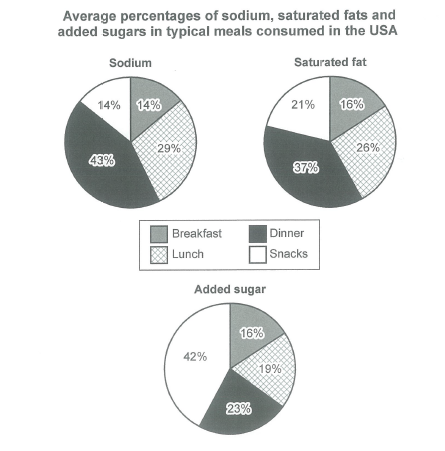
The charts below show the average percentages in typical meals of three types of nutrients, all of which may be unhealthy if eaten too much.
Summarize the information by selecting and reporting the main features, and make comparisons where relevant.
Student answer (Band 5.5)
this given chart discribes about kind of meals, which inclued various type of nutrients.which can do more bad then good if it consume too much without having any limitation.
as i can see from the pie at dinner we consume most ammount of sodium(43%) and saturated fat (37%).but the least ammount of these two nutrients we take is in the morning when we have our breakfast which is appromextly 14% and 21%.but the second thing we consume these is the lunch time which is 29% and 26% but when we have snackes sodium consumtion remains as breakfast time but fat slightly incresed to 21%.
on the other hand added suger also consumed a lot. as this graph showing we consume suger in snacks time more than any other thing expect sodium which is only 1% higher than suger.althoug suger stays at 42%.but at breakfast we taken same ammount of suger as fat.while we take less suger then both sodium and fat at lunch.only 19%.also at dinner we consume less suger then any other ingrediunts as of 23%.
AI examiner evaluation
| Criterion | Band |
|---|---|
| Task Achievement / Task Response | 5.5 |
| Coherence and Cohesion | 5.5 |
| Lexical Resource | 5.0 |
| Grammatical Range and Accuracy | 5.0 |
| Overall | 5.5 |
Task Achievement / Task Response: Band 5.5
You identify several important patterns, including dinner having the highest shares of sodium and saturated fat, and snacks having the highest share of added sugar. You also include relevant figures such as 43%, 37% and 42%. However, the response does not provide a clear, concise overview of the main comparisons, and some details are inaccurate: breakfast and snacks both have 14% sodium, but breakfast has the lowest saturated-fat share at 16%, not 21%; 21% belongs to snacks. The claim that snack sugar is only 1% higher than sodium is also incorrect, since snack sodium is 14%. A more systematic comparison of all three nutrients, with accurate figures and a distinct overview, would make the report more complete.
Coherence and Cohesion: Band 5.5
The response has a broadly understandable sequence: it first discusses sodium and saturated fat, then turns to added sugar. Linking expressions such as “on the other hand” and “but” show an attempt to connect comparisons. However, the information is presented in two long, crowded paragraphs, and the progression within them is difficult to follow. Several comparisons are packed into single sentences, while repeated “but” and “also” do not always make the relationship between figures clear. For example, the sentence about snack sodium and fat combines a comparison with breakfast and an unclear contrast. Use a brief overview followed by separate, logically ordered comparisons, and make each sentence focus on one clear relationship.
Lexical Resource: Band 5.0
You use some relevant topic vocabulary, including “sodium,” “saturated fat,” “added sugar,” “consumed” and “percentage,” so the reader can generally identify the subject of each comparison. However, the range is limited and several words or phrases are inaccurate or repeated, such as “ammount,” “consume,” and “thing.” Spelling errors—including “discribes,” “nutrients,” “suger” and “snackes”—are noticeable and sometimes make reading less smooth. Some expressions are also unnatural for describing chart data, such as “in the morning when we have our breakfast” and “snacks time.” Aim for precise chart-reporting language, such as “accounted for,” “proportion” and “meal,” and check spelling and word forms carefully.
Grammatical Range and Accuracy: Band 5.0
You attempt to combine ideas using clauses, for example, “when we have snacks sodium consumption remains as breakfast time,” and you use some comparative structures. However, sentence control is inconsistent, and many sentences contain errors in agreement, articles, verb forms or punctuation. In “which can do more bad then good if it consume,” the pronoun and verb do not agree, and the clause is awkwardly formed. “At dinner we consume most amount” also needs a more accurate grammatical construction, while several sentences run together without full stops. The response relies heavily on long sentences joined by “but” and “while.” Practise writing shorter, complete sentences first, then add a controlled range of subordinate clauses and check agreement and punctuation.
See this exact question answered at other band scores. The same prompt compared across bands.
Browse more IELTS Writing model answers or get your own writing scored by the same AI examiner.