Band 6.0 IELTS Writing Task 1 Model Answer
Overall Band Score: 6.0 · Cambridge IELTS 14 · 2026-11-19
IELTS Writing Task 1 question
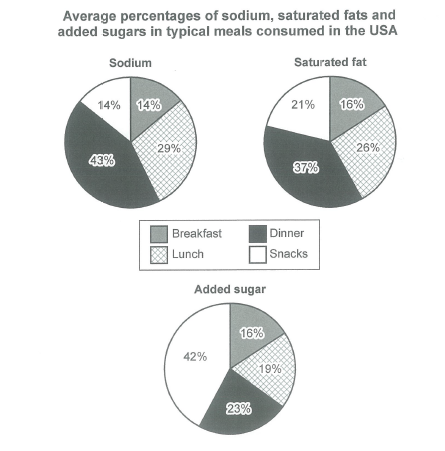
The charts below show the average percentages in typical meals of three types of nutrients, all of which may be unhealthy if eaten too much.
Summarize the information by selecting and reporting the main features, and make comparisons where relevant.
Student answer (Band 6.0)
The charts given under represents the common portions in daily diet of thrice kinds of nutrients, every portion could be unhealthy if eaten more often.
Overall, Sodium and saturated fats are taken highest in dinner while added sugar is the most in snacks. Sodium is consumed lowest in Snacks and Breakfast
To commence with, In the breakfast sdium is consumed exact 14%, saturated fat in 16% and added sugar in 16% as well. In the lunch sodium is consumed exact 29%, saturated fats in 26% and added sugar is absolutely 19%.
On the other hand, In the dinner sodium shares highest in any of 43%, saturated fats are also very high exact 37 % and added sugar is comperatively low around 23%. The time of snacks share the portion of sodium exactly 14%, amount of saturated fats shares 21% and added sugar tops the chart with the exact amount of 42%
AI examiner evaluation
| Criterion | Band |
|---|---|
| Task Achievement / Task Response | 7.0 |
| Coherence and Cohesion | 6.5 |
| Lexical Resource | 5.5 |
| Grammatical Range and Accuracy | 5.0 |
| Overall | 6.0 |
Task Achievement / Task Response: Band 7.0
You identify the main pattern accurately: sodium and saturated fat peak at dinner, while added sugar is highest in snacks. The overview also notes that sodium is lowest in breakfast and snacks, which matches the figures. Your body paragraphs report all twelve percentages correctly and make relevant comparisons, including the contrast between dinner’s 43% sodium and snacks’ 42% added sugar. This gives the response clear coverage of the chart and supports its main points. To make the account more fully developed, sharpen the overview by comparing the relative patterns across all three nutrients—for example, dinner leads for two nutrients, whereas snacks lead for sugar—and avoid vague descriptions such as “very high” when the figures themselves can show the scale.
Coherence and Cohesion: Band 6.5
The response has a recognisable structure: an introduction, an overview, and two paragraphs grouping breakfast and lunch separately from dinner and snacks. This makes the information easy to follow, and transitions such as “On the other hand” signal a shift to the remaining meals. The progression is generally logical, but cohesion is not always smooth: “To commence with” is rather formulaic, and the repeated “In the…” openings make the reporting feel list-like. The overview’s second sentence is also not clearly connected to the first. For stronger progression, group comparisons by pattern (for example, the dinner peaks versus the snack sugar peak) and use concise linking phrases that clarify those relationships.
Lexical Resource: Band 5.5
You use relevant chart vocabulary, including “consumed,” “shares,” “portion,” and “tops the chart,” so the reader can understand the comparisons. However, the range is limited and several choices are inaccurate or unnatural, which keeps the description from being consistently precise. “Common portions in daily diet” does not clearly describe the chart’s percentages, while “thrice kinds of nutrients” is an awkward way to introduce the three nutrients. There are also spelling errors such as “sdium” and “comperatively,” and “exact” is repeated where a neutral reporting verb would be more natural. Aim for accurate collocations such as “accounted for” or “made up,” and use “percentage” or “proportion” consistently when describing the data.
Grammatical Range and Accuracy: Band 5.0
Your response communicates the main information, but grammatical control is uneven and sentence structures are mostly simple or list-like. The opening, “The charts given under represents,” has a subject–verb agreement error, and “In the breakfast sdium is consumed exact 14%” lacks a clear grammatical structure for reporting a figure. Several sentences omit articles or use awkward sentence patterns, while punctuation and capitalisation are inconsistent, as in “To commence with, In the breakfast…” The final sentence also runs several data points together without clear punctuation. Practise reliable chart-reporting frames such as “Sodium accounted for 14% at breakfast” and combine related figures using accurate clauses and punctuation.
See this exact question answered at other band scores. The same prompt compared across bands.
Browse more IELTS Writing model answers or get your own writing scored by the same AI examiner.