Band 6.0 IELTS Writing Task 1 Model Answer
Overall Band Score: 6.0 · Cambridge IELTS 14 · 2026-11-19
IELTS Writing Task 1 question
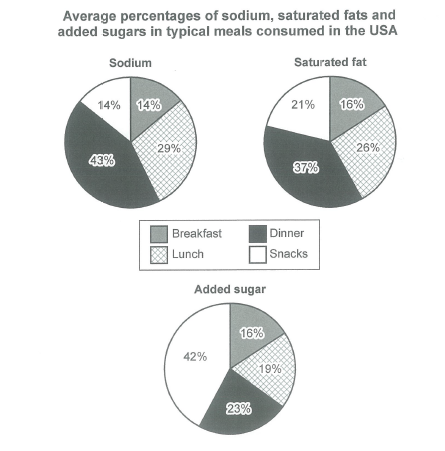
The charts below show the average percentages in typical meals of three types of nutrients, all of which may be unhealthy if eaten too much.
Summarize the information by selecting and reporting the main features, and make comparisons where relevant.
Student answer (Band 6.0)
The pie charts illustrate the average percentages in typical meals of three categories of elemnts : sodium, saturated fats and added sugar cunsumed in the USA.
Overall, sodium and saturated fats had the highest consumption at dinner. Meanwhile, added sugar was the most nutrient consumed in snacks. Breakfast had the least amounts of all ingredients.
Sodium had almost half of total percentage in dinner (43%), while it shared the same amount in snacks and breakfast by 14% each. Meanwhile lunch had a 29% almost the sum of breakfast and snacks. Saturated fats followed the same pattern with a high percentage in dinner (37%) where its as well the sum of the amount in breakfast and snacks. Lunch had the second place with 26%.
On the other hand, a 42% of added sugar was highly noticeable in snacks followed by dinner with a 23%, while respectively an average of 19% in lunch and 16% in breakfast.
AI examiner evaluation
| Criterion | Band |
|---|---|
| Task Achievement / Task Response | 6.0 |
| Coherence and Cohesion | 6.0 |
| Lexical Resource | 5.5 |
| Grammatical Range and Accuracy | 5.5 |
| Overall | 6.0 |
Task Achievement / Task Response: Band 6.0
You identify the chart topic and give a clear overview: dinner has the highest shares of sodium and saturated fat, while snacks lead for added sugar. You also report the main figures accurately, including the 43% dinner share for sodium and 42% snack share for added sugar, and make relevant comparisons across meals. However, the breakfast claim that it had the least amounts of all ingredients is not accurate: snacks and breakfast are tied for the lowest sodium share, and breakfast is not the lowest for saturated fat. The comparison that lunch sodium is “almost the sum” of breakfast and snacks is also imprecise. The response is 147 words, three short of the 150-word minimum; develop the overview or comparisons slightly further to meet it and clarify these points.
Coherence and Cohesion: Band 6.0
The response has a coherent overall arrangement: an introduction, a summary of the main patterns, and separate discussion of sodium and saturated fat followed by added sugar. This makes the information easy to follow. Linking expressions such as “Overall,” “Meanwhile,” and “On the other hand” help signal relationships between points. Some connections are less clear or feel mechanical, however. For example, “Meanwhile lunch had a 29% almost the sum of breakfast and snacks” is difficult to interpret, and “where its as well the sum” does not clearly explain the comparison. Grouping the meal comparisons more consistently and using precise references to the figures would improve progression and cohesion.
Lexical Resource: Band 5.5
You use relevant chart vocabulary, including “average percentages,” “consumption,” “followed,” and “followed by,” and the reader can generally understand the comparisons. There is some variety in how you describe the data, but several word-choice and collocation problems reduce precision: “highest consumption” is less suitable than describing the highest percentage, and “the most nutrient consumed” is inaccurate because the chart reports shares of added sugar, not quantities of nutrients consumed. Spelling errors such as “elemnts” and “cunsumed” are noticeable, while “a high percentage” and “second place” are somewhat informal or imprecise for this report. Check spelling and choose terms that describe proportions directly.
Grammatical Range and Accuracy: Band 5.5
You use a mix of simple and more complex forms, including the contrast introduced by “while” and the relative clause in “where its as well the sum.” Most of the intended meaning remains understandable, but some grammatical errors affect clarity. For example, “Sodium had almost half of total percentage in dinner” is missing an article and has an awkward structure; “lunch had a 29%” uses an unnecessary article; and “where its as well the sum” has an unclear clause structure and incorrect pronoun form. The sentence beginning “Meanwhile lunch had…” also lacks a clear grammatical link between the percentage and the comparison. Practise accurate article use and build comparisons with complete, clearly structured clauses.
See this exact question answered at other band scores. The same prompt compared across bands.
Browse more IELTS Writing model answers or get your own writing scored by the same AI examiner.