Band 4.0 IELTS Writing Task 1 Model Answer
Overall Band Score: 4.0 · Cambridge IELTS 14 · 2026-11-19
IELTS Writing Task 1 question
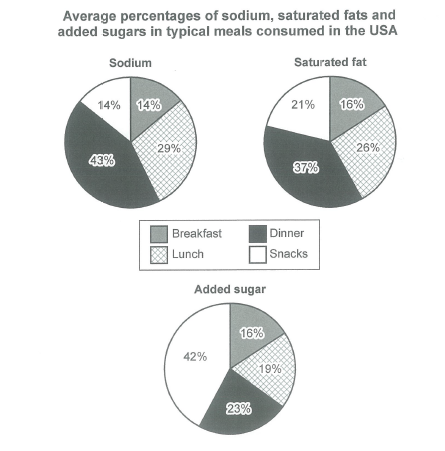
The charts below show the average percentages in typical meals of three types of nutrients, all of which may be unhealthy if eaten too much.
Summarize the information by selecting and reporting the main features, and make comparisons where relevant.
Student answer (Band 4.0)
The pie chart compares the proportion of nutrients like sodium, saturated fat and added sugar in meals in US which cause harmful if taken in large quantity.
Overall we can see that, The large amount of nutrients consumed was at dinner and snacks while the least was in breakfast.
AI examiner evaluation
| Criterion | Band |
|---|---|
| Task Achievement / Task Response | 3.0 |
| Coherence and Cohesion | 4.5 |
| Lexical Resource | 4.5 |
| Grammatical Range and Accuracy | 4.5 |
| Overall | 4.0 |
Task Achievement / Task Response: Band 3.0
The response identifies the chart’s subject and attempts an overall statement, but it reports almost none of the information needed to summarise the data. The claim that the largest amounts were at dinner and snacks is too broad: dinner is highest for sodium and saturated fat, whereas snacks are highest for added sugar. Breakfast is indeed the lowest category for all three nutrients, but this is not explained or supported with figures. The response also omits the key comparisons and all specific percentages. The required minimum length is not met, leaving the task only minimally addressed. To improve, give a clear overview of the contrasting peaks, then select and compare the main figures for each meal.
Coherence and Cohesion: Band 4.5
The response has a basic two-part structure: an opening sentence introduces the chart, followed by a separate overview beginning with “Overall”. This gives the reader a simple progression from topic to main impression. However, the second paragraph is only a single, general statement, and there is no organised reporting of individual nutrients or comparisons. The link between “dinner and snacks” and the three different nutrient patterns is also unclear. Develop the response into a brief introduction, an overview, and one or two paragraphs grouping the data logically—for example, dinner’s high sodium and saturated-fat shares versus snacks’ high added-sugar share. Use clear references to the nutrient and meal categories throughout.
Lexical Resource: Band 4.5
The vocabulary is sufficient to identify the chart’s topic, with terms such as “sodium”, “saturated fat”, “added sugar” and “proportion”. However, the range is narrow, and some word choices or combinations are inaccurate or unnatural: “nutrients like” is imprecise for naming the three categories, while “cause harmful” does not express the intended meaning clearly. “Large amount” is also vague when describing percentages. Use precise chart language such as “share”, “accounted for”, “highest proportion” and “lowest figure”, and distinguish the three nutrients rather than grouping them as one amount. More varied, accurate vocabulary would make the comparisons clearer and more appropriate to an academic report.
Grammatical Range and Accuracy: Band 4.5
The response uses simple sentence forms that communicate the general topic, and the opening sentence attempts a relative clause with “which”. However, grammatical control is uneven. In “meals in US”, the country name needs an article, and “which cause harmful” has an incomplete construction; a grammatical version would be “which may be harmful if consumed in large quantities”. The overview also has an unnecessary capital after the comma in “Overall we can see that, The…”, and its sentence structure is awkward. There is little variety beyond basic clauses. Practise accurate article use, complete conditional clauses, and punctuation, then use a mix of simple and complex sentences to compare the figures.
See this exact question answered at other band scores. The same prompt compared across bands.
Browse more IELTS Writing model answers or get your own writing scored by the same AI examiner.