Band 5.5 IELTS Writing Task 1 Model Answer
Overall Band Score: 5.5 · Cambridge IELTS 14 · 2026-11-20
IELTS Writing Task 1 question
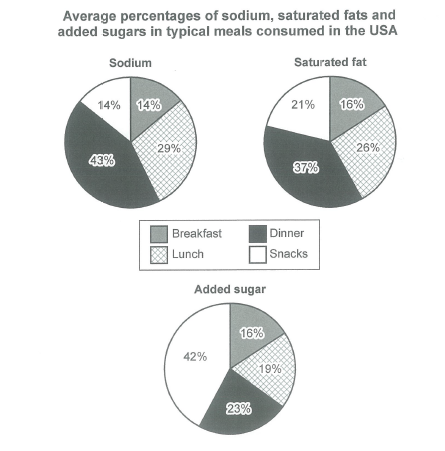
The charts below show the average percentages in typical meals of three types of nutrients, all of which may be unhealthy if eaten too much.
Summarize the information by selecting and reporting the main features, and make comparisons where relevant.
Student answer (Band 5.5)
The pie chart give the information about average proportion. It typical meals of three types of nutrients such as sodium , saturated fat and added sugar. It is counsumed in the USA. All of which may be unhealthy if people intake it too much. Overall, it is clear that dinner contain the highest proportion of sodium and saturated fat.While Snack contain the highest proportion of addedd sugar. In contrast, Breakfast contain the lowest propoetion in all three nutrients.
It is quite evident For sodium, dinner accounts for 43%, which is sgnificantly higher than the lunch at 29%. Both breakfast and snack are much lower at 14%. Similarly. for saturated fat dinner is the 37% and lunch at 26%. Snack make 21%, while, breakfast is much lowest at 37%.
However, for added sugar snacks are the highest at 42% and dinner at 23%, while lunch make up 19% and breakfast id loweest at 16%.
AI examiner evaluation
| Criterion | Band |
|---|---|
| Task Achievement / Task Response | 6.0 |
| Coherence and Cohesion | 6.0 |
| Lexical Resource | 5.5 |
| Grammatical Range and Accuracy | 5.0 |
| Overall | 5.5 |
Task Achievement / Task Response: Band 6.0
You identify the main pattern accurately: dinner has the highest shares of sodium and saturated fat, while snacks lead in added sugar, and breakfast is generally low. The overview is relevant and the figures for sodium and added sugar are reported correctly. However, there is an important data error: you say breakfast is the lowest for all three nutrients, but snacks and breakfast are tied at 14% for sodium. You also give breakfast’s saturated-fat figure as 37%; the chart shows 16%, with snacks at 21%. This makes one comparison inaccurate and weakens coverage of the chart. To strengthen the report, check each figure carefully and include the correct breakfast–snack comparison for saturated fat.
Coherence and Cohesion: Band 6.0
The response has a recognisable structure: an introduction and overview are followed by details on sodium and saturated fat, then added sugar. This gives the reader a generally coherent route through the information, and phrases such as “Overall” and “However” help signal shifts. Cohesion is sometimes faulty or mechanical, though. For example, “Similarly.” is separated from the sentence it introduces, and “while” is used inconsistently to connect comparisons. The overview also combines several claims in a crowded passage. Use clear paragraph breaks and connect each comparison with accurate, varied linking phrases; ensure punctuation supports the relationship between clauses.
Lexical Resource: Band 5.5
You use relevant chart vocabulary, including “proportion,” “accounts for,” “highest,” and “lowest,” so the main comparisons are understandable. There is some attempt to vary expression, but word choice, spelling, and collocation errors are noticeable: “counsumed,” “addedd,” and “propoetion” are misspelled, while “intake it too much” is not a natural way to describe excessive consumption. “Snack make” also uses an imprecise form for the chart category. These slips reduce the accuracy and polish of the report, even though the intended meaning is usually clear. Proofread spelling and choose standard data-reporting phrases such as “consumed in excess” and “snacks account for.”
Grammatical Range and Accuracy: Band 5.0
You attempt both simple statements and more developed comparisons, for example, “dinner accounts for 43%, which is significantly higher than the lunch at 29%.” However, grammatical control is uneven, and several errors affect sentence accuracy. The opening has an incomplete construction: “The pie chart give the information about average proportion. It typical meals…”; the second sentence lacks a main verb. Subject–verb agreement is also inconsistent in “dinner contain” and “snacks are,” and articles are awkward in “the lunch” and “the 37%.” The final sentence includes “breakfast id loweest,” which also disrupts the clause. Practise complete sentence patterns, agreement, and article use, then check punctuation and verb forms.
See this exact question answered at other band scores. The same prompt compared across bands.
Browse more IELTS Writing model answers or get your own writing scored by the same AI examiner.