Band 6.0 IELTS Writing Task 1 Model Answer
Overall Band Score: 6.0 · Cambridge IELTS 14 · 2026-11-20
IELTS Writing Task 1 question
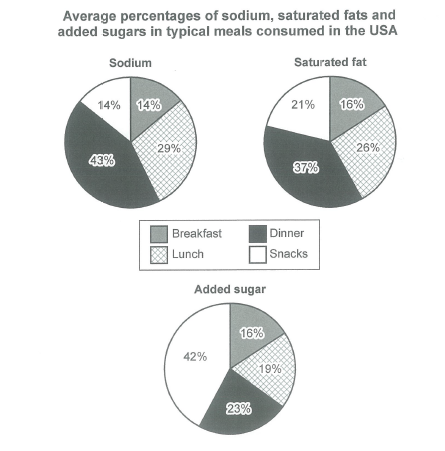
The charts below show the average percentages in typical meals of three types of nutrients, all of which may be unhealthy if eaten too much.
Summarize the information by selecting and reporting the main features, and make comparisons where relevant.
Student answer (Band 6.0)
The three pie charts illustrate the average percentages of sodium, saturated fat and added sugar in four typical meals consumed in the USA.
Overall, Sodium and saturated fat accounted for the most in dinner with values of 43% and 37% respectively. While, added sugar constitute the most in snacks. Each of the meal contains significant amount of these three nutrients in them, ranging from the least contribution of 14% to having a highest of 43% in some meals.These pie charts depict that sodium and saturated fats must be avoided in dinner and lunch, added sugars in snacks and breakfast in order to stay healthy.
Sodium is equally present in snacks and breakfast with value of 14% and in lunch it is having a percentage of 29%.On the other hand, Saturated fat shared different percentages for snacks, breakfast and lunch which are 21%,16% and 26% respectively.
Meanwhile, Added sugar dominates the most in snacks with a contribution of 42%. Dinner also contains a 23% of added sugar. Lunch accounts for 19%. While, breakfast constitutes a value of 16% added sugar.
AI examiner evaluation
| Criterion | Band |
|---|---|
| Task Achievement / Task Response | 6.0 |
| Coherence and Cohesion | 6.0 |
| Lexical Resource | 5.5 |
| Grammatical Range and Accuracy | 5.5 |
| Overall | 6.0 |
Task Achievement / Task Response: Band 6.0
You identify the charts and give a relevant overview: dinner has the highest shares of sodium and saturated fat, while snacks lead for added sugar. You also report several accurate figures, including sodium at 29% in lunch and added sugar at 42% in snacks. However, the overview is not fully precise: the claim that sodium and saturated fat “must be avoided” in dinner and lunch is advice rather than a summary of the data, and breakfast is not a leading meal for added sugar. Some comparisons are also incomplete; for example, the dinner sodium figure is given in the overview but not discussed in the detail paragraphs. A clearer overview and more systematic coverage of the main highs and lows would make the report more complete.
Coherence and Cohesion: Band 6.0
The response has a recognisable structure, moving from an introduction and overview to details about sodium and saturated fat, then added sugar. This makes the information generally easy to follow. However, progression is weakened by the advice inserted into the overview (“must be avoided”), which interrupts the chart summary, and by some mechanical or awkward linking, such as “On the other hand” where the sentence simply adds another set of figures. The final paragraph also repeats the added-sugar ranking without linking it to the earlier overview. Use clearer grouping—such as comparing all three nutrients by meal or highlighting each nutrient’s highest and lowest values—and reserve connectors for relationships they accurately express.
Lexical Resource: Band 5.5
You use relevant chart vocabulary, including “average percentages,” “accounted for,” “contribution,” and “dominates,” so the topic is clear. There is some variety in how you describe proportions, but several choices are unnatural or imprecise: “accounted for the most in dinner,” “shared different percentages,” and “contains significant amount” do not express the data idiomatically. “Must be avoided” also introduces an unsupported recommendation rather than a neutral description. Aim for standard reporting collocations such as “the highest proportion was recorded at dinner” and “made up 21%.” Check capitalisation of nutrient names, which should not be capitalised mid-sentence. More precise, natural phrasing would improve clarity and control.
Grammatical Range and Accuracy: Band 5.5
You attempt both simple and more complex sentence forms, and the main comparisons are usually understandable. However, some errors in agreement, verb form, articles, and punctuation remain. For example, “added sugar constitute” should be “added sugar constituted” or “constitutes,” while “Each of the meal contains” needs a plural noun and a more suitable agreement pattern. In “Dinner also contains a 23%,” the article is unnecessary, and “While, breakfast constitutes…” is an incorrectly punctuated fragment. Several sentences also run together because spaces after full stops are missing. Review subject–verb agreement and sentence boundaries, and use complete clauses consistently; this would make the report more accurate while retaining its range of structures.
See this exact question answered at other band scores. The same prompt compared across bands.
Browse more IELTS Writing model answers or get your own writing scored by the same AI examiner.