Band 5.0 IELTS Writing Task 1 Model Answer
Overall Band Score: 5.0 · Cambridge IELTS 14 · 2026-11-20
IELTS Writing Task 1 question
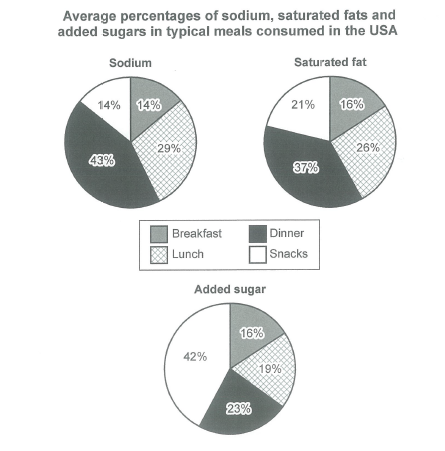
The charts below show the average percentages in typical meals of three types of nutrients, all of which may be unhealthy if eaten too much.
Summarize the information by selecting and reporting the main features, and make comparisons where relevant.
Student answer (Band 5.0)
During breakfast and snacks sodium is used at moderate level according to the given pie charts. However, the quantity of it in being drasticaly consumed more at dinner and slightly less at dinner. If we talk about saturated fat it is lower in only lunch time while in other cases lunch, dinner, breakfast it is more than sodium. So, the consumptions of saturated fast have more usage than sodium during meal time.
Suger in snacks is in massive amount during breakfast. The sugar amount is same approximately, as compare to the sodium and saturated fat during breakfast. At lunch the sugar level reduce to half use as comparison to the breakfast use. Dinner also have less amount sugar.
All the three percentages are being consumed differently in all meals time. and some of them contain same amount and some contain's completely different amount of the nutrients. Only in breakfast the amount of all three are approximately equal.
AI examiner evaluation
| Criterion | Band |
|---|---|
| Task Achievement / Task Response | 5.0 |
| Coherence and Cohesion | 5.0 |
| Lexical Resource | 5.0 |
| Grammatical Range and Accuracy | 5.0 |
| Overall | 5.0 |
Task Achievement / Task Response: Band 5.0
You identify some relevant patterns, including that dinner has the highest sodium share and snacks have the highest added-sugar share. However, the account is only partial and several comparisons are inaccurate or unclear. For example, sodium is not “slightly less at dinner”: dinner is the peak at 43%, while breakfast and snacks are both 14%. The statement that saturated fat is lower “in only lunch time” is also incorrect; its lowest share is breakfast at 16%, and it exceeds sodium at breakfast, lunch and snacks, but not dinner. The overview that breakfast values are approximately equal is broadly supported, but the response needs a clearer summary of the main contrasts and more accurate reporting of the figures.
Coherence and Cohesion: Band 5.0
The response has some paragraphing and attempts to group information by nutrient, so the reader can recognise the broad topic of each section. However, there is no clear overall progression from an overview to well-organised comparisons, and several links between ideas are confusing. For instance, “lower in only lunch time while in other cases lunch, dinner, breakfast” repeats lunch and makes the comparison difficult to follow. The final paragraph repeats the general point that the values differ without adding a useful comparison. Use a brief overview first, then organise the details consistently by meal or nutrient, and use clear references such as “this figure” only when the referent is unmistakable.
Lexical Resource: Band 5.0
You use some task-related vocabulary, including “sodium,” “saturated fat,” “consumed” and “amount,” which helps convey the subject. However, the range is limited and several word choices or collocations make the meaning unclear, such as “used at moderate level,” “massive amount during breakfast” and “more usage than sodium.” There are also noticeable spelling and word-form errors, including “drasticaly,” “Suger” and “fast” for “fat.” Aim for precise chart language: describe percentages as “accounting for” a share or “being highest/lowest,” rather than saying a nutrient is used. Check spelling carefully and avoid repeating “amount” when “proportion” or “percentage” is more accurate.
Grammatical Range and Accuracy: Band 5.0
You attempt some longer sentences and use basic comparison structures, but the range is limited and errors are frequent enough to make several statements hard to interpret. Examples include “the quantity of it in being drasticaly consumed more” and “Dinner also have less amount sugar,” where sentence structure, verb form and missing grammatical words interfere with meaning. Agreement is also inconsistent in “All the three percentages are being consumed differently” and “some contain's.” The sentence “At lunch the sugar level reduce to half use” has an incorrect verb form and an incomplete comparison. Build clearer sentences around a subject and verb, check singular/plural agreement, and use simple accurate patterns such as “The figure for dinner was…” before attempting more complex comparisons.
See this exact question answered at other band scores. The same prompt compared across bands.
Browse more IELTS Writing model answers or get your own writing scored by the same AI examiner.