Band 6.5 IELTS Writing Task 1 Model Answer
Overall Band Score: 6.5 · Cambridge IELTS 14 · 2026-11-20
IELTS Writing Task 1 question
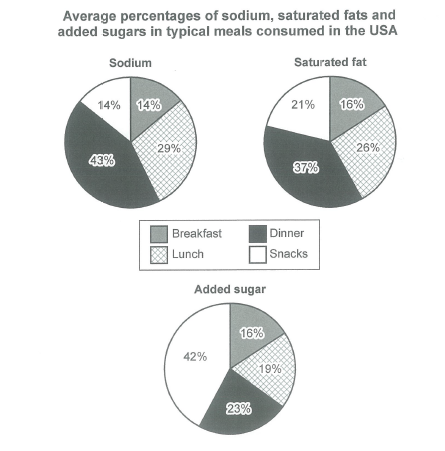
The charts below show the average percentages in typical meals of three types of nutrients, all of which may be unhealthy if eaten too much.
Summarize the information by selecting and reporting the main features, and make comparisons where relevant.
Student answer (Band 6.5)
The three pie charts illustrate the average proportion of three nutrients ( sodium, saturated fat, added sugar) in typical meals in the USA. These nutrients may be become harmful if eaten too much.
Overall, sodium and saturated fat have relatively similar distribution through the four typical meals, whereas added sugar variey considerably. Dinner by far has the largest share of sodium and saturated fat in contrast snacks has the highest share of added sugar.
43% of sodium is consumed during dinner time, making it the highest share. Lunch rank second at 29%, followed by breakfast and dinner each account for 14%, each joint the lowest share.
In terms of saturated fat, 37% consumed also during the dinner, followed by lunch at 26%. Snacks ranck third at 21%. Breakfast has the lowest share at 16%.
Added sugar has different pattern among the four typical meals. Snacks accounted for 42% of total consumption whereas dinner for 23%. Lunch represents 19% of total consumption in contrast breakfast account for 19%.
AI examiner evaluation
| Criterion | Band |
|---|---|
| Task Achievement / Task Response | 7.0 |
| Coherence and Cohesion | 6.5 |
| Lexical Resource | 6.0 |
| Grammatical Range and Accuracy | 5.5 |
| Overall | 6.5 |
Task Achievement / Task Response: Band 7.0
You identify the main pattern clearly: sodium and saturated fat peak at dinner, while added sugar is highest in snacks. The overview is relevant, and the response reports most key figures accurately, including dinner’s 43% sodium and 37% saturated fat, and snacks’ 42% added sugar. However, there are two data inaccuracies: breakfast and snacks each account for 14% of sodium, not breakfast and dinner, and breakfast’s added-sugar share is 16%, not 19%. The latter figure belongs to lunch’s comparison only in your text, so the final contrast is misleading. The task is otherwise addressed with relevant comparisons; checking each figure against the chart would make the reporting more consistently precise.
Coherence and Cohesion: Band 6.5
The response has a clear overall structure: an introduction, a summary of the main trends, and separate paragraphs for each nutrient. This makes the information easy to follow, and comparisons such as dinner versus lunch for saturated fat are placed logically. The overview also gives the reader a useful framework before the details. To strengthen progression further, make the comparisons within each paragraph more explicit and avoid relying repeatedly on simple sequencing such as “followed by.” The final added-sugar paragraph would benefit from a clearer ordering of all four meals, and its contrast between lunch and breakfast is confusing because the figures are not accurately distinguished. More precise linking and reference would make cohesion smoother.
Lexical Resource: Band 6.0
You use an adequate range of chart-reporting vocabulary, including “proportion,” “distribution,” “largest share,” and “accounted for.” These choices generally communicate the comparisons clearly. However, some word choices and collocations are inaccurate or awkward, such as “dinner time,” “share of total consumption,” and “Dinner by far has the largest share.” There are also spelling errors in “variey” and “ranck,” which reduce accuracy. Aim for consistent, natural phrasing such as “the proportion consumed at dinner” and “ranked third.” Avoid repeating “share” where alternatives such as “percentage” or “figure” would be more precise. These refinements would improve control without requiring unnecessarily complex vocabulary.
Grammatical Range and Accuracy: Band 5.5
You attempt a mixture of simple and more complex forms, including the contrast in “whereas added sugar…” and the participial phrase “making it the highest share.” Meaning is usually recoverable, but some grammatical errors remain. For example, “These nutrients may be become harmful” has an incorrect verb construction; use “may become harmful.” In “37% consumed also during the dinner,” the sentence needs a verb, as in “37% was also consumed at dinner.” The sentence beginning “Lunch represents 19%” shifts tense and has an incomplete contrast, while “breakfast account” has subject–verb disagreement. Review complete sentence structure, verb forms, and agreement, and aim to produce more consistently accurate sentences alongside your range.
See this exact question answered at other band scores. The same prompt compared across bands.
Browse more IELTS Writing model answers or get your own writing scored by the same AI examiner.