Band 6.0 IELTS Writing Task 1 Model Answer
Overall Band Score: 6.0 · Cambridge IELTS 14 · 2026-11-20
IELTS Writing Task 1 question
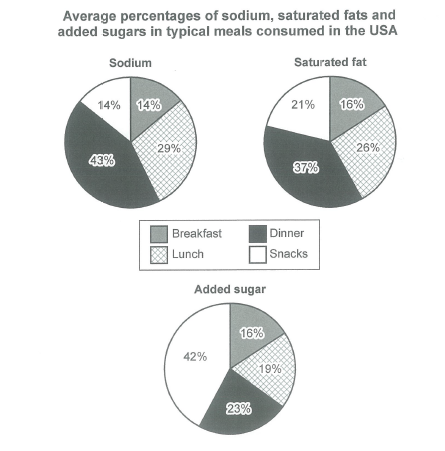
The charts below show the average percentages in typical meals of three types of nutrients, all of which may be unhealthy if eaten too much.
Summarize the information by selecting and reporting the main features, and make comparisons where relevant.
Student answer (Band 6.0)
The charts illustrates the average percentages of nutrients namely Sodium, saturated fat, and added sugar in meals which tend to be harmful to health if consumed in high proportion.
Overall, people consume high level of sodium and added sugar during thier meals. The percentage of sodium remains high in dinners whereas, added sugar is mostly eaten during snacks. However, the breakfasts contain the least amounts of all three types of nutreints.
people consume 43% of sodium in dinner and 29% during lunch. However, only 14% is added in their breakfasts and snacks. Whereas, in case of saturated fat, dinners have 37%, 26% is eaten during lunch, 21% during snacking and only 16% in breakfasts.
In contrats, 42% of added sugar is being consumed during snacking making is highest in percentage after sodium. 23% of it is added in dinner meals. people add 19% of sugar in lunch. Lastly, breakfast items contain only 16% of sugar.
AI examiner evaluation
| Criterion | Band |
|---|---|
| Task Achievement / Task Response | 7.0 |
| Coherence and Cohesion | 6.0 |
| Lexical Resource | 5.5 |
| Grammatical Range and Accuracy | 5.5 |
| Overall | 6.0 |
Task Achievement / Task Response: Band 7.0
The response identifies the main pattern accurately: dinner has the highest shares of sodium and saturated fat, while snacks account for the most added sugar. It also reports the key figures for all three nutrients, including the low breakfast proportions, so the chart is addressed clearly and relevantly. The overview is useful, although “people consume high level of sodium and added sugar during their meals” is too broad: the figures vary by meal, and added sugar peaks at snacks rather than across meals generally. Also, “breakfasts contain the least amounts of all three” is not quite precise, since sodium is equally low at breakfast and snacks (14%). A more carefully qualified overview would make the main comparisons more exact and fully supported by the data.
Coherence and Cohesion: Band 6.0
The response has a clear overall structure: an introduction, an overview, and two detail paragraphs that group the nutrient figures. This makes the information easy to follow. However, cohesion is sometimes mechanical or unclear. Repeated use of “However,” “Whereas,” and “In contrast” does not always show a genuine contrast, and the sentence beginning “Whereas, in case of saturated fat” is an awkward continuation after a full stop. The final paragraph also repeats the breakfast figure after it has already been mentioned. Use fewer, more precise linking expressions and organise each detail paragraph around a clear comparison—for example, dinner versus snacks—rather than listing figures with repeated transitions.
Lexical Resource: Band 5.5
The response uses relevant chart vocabulary, including “average percentages,” “saturated fat,” “added sugar,” and “consumed,” and the reader can understand the comparisons. However, the range is limited and several word-choice, collocation, and spelling problems reduce precision. “High level” should be “high levels,” while “added in their breakfasts” is not a natural way to describe a proportion of nutrient intake. “In contrats” and “nutreints” are spelling errors, and “making is highest in percentage” is unclear. There is also repetition of “people consume” and “during.” Aim for accurate reporting verbs and collocations such as “account for,” “make up,” and “the proportion of added sugar,” while checking spelling carefully.
Grammatical Range and Accuracy: Band 5.5
There is some variety in sentence forms, including a relative clause in the opening and contrast clauses in the body, and the intended meaning is generally recoverable. However, some errors in agreement, sentence construction, articles, and punctuation remain. “The charts illustrates” should be “The charts illustrate,” and “people consume high level” needs an article or plural form. The sentence “Whereas, in case of saturated fat, dinners have 37%, 26% is eaten…” joins two structures awkwardly; it would be clearer as two coordinated clauses or a properly formed comparison. Capitalisation is also inconsistent at the starts of paragraphs and sentences. More controlled sentence boundaries and accurate agreement would improve clarity while allowing you to retain varied structures.
See this exact question answered at other band scores. The same prompt compared across bands.
Browse more IELTS Writing model answers or get your own writing scored by the same AI examiner.