Band 6.0 IELTS Writing Task 1 Model Answer
Overall Band Score: 6.0 · Cambridge IELTS 14 · 2026-11-21
IELTS Writing Task 1 question
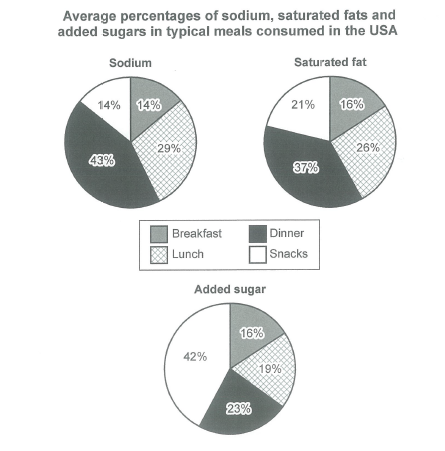
The charts below show the average percentages in typical meals of three types of nutrients, all of which may be unhealthy if eaten too much.
Summarize the information by selecting and reporting the main features, and make comparisons where relevant.
Student answer (Band 6.0)
The given piecharts compares the amount of three nutrients that are derived from the typical meals.
Overally, dinner posses maximum amount of sodium, saturated fats and added sugar and breakfast provide low content of these nutrients.
Highest amount of sodium that is 43% came from the dinner followed by lunch with 29%. Althought, breakfast and snacks posses equal amount of sodium i.e. 14%.Additionally, when it's comes to Saturated fat, again dinner contribute high amount of saturated fat with the 37% followed by 26% from lunch and 21% form snacks. Here, Breakfast contribute lower saturated fat with the 16% as compared to other meals.
Additionally, about 42% of the added sugar came from the snacks meals which is the highest among the contribution of added sugar. Moreever, 23% of sugar was supplied by dinner meals followed by 19% from the lunch foods. However, only 16% of added sugar is came from breakfast food which is kind of good for the health because maximum percentage of these nutrients cause the health problem and invite the different disease.
AI examiner evaluation
| Criterion | Band |
|---|---|
| Task Achievement / Task Response | 7.0 |
| Coherence and Cohesion | 6.5 |
| Lexical Resource | 5.5 |
| Grammatical Range and Accuracy | 5.5 |
| Overall | 6.0 |
Task Achievement / Task Response: Band 7.0
The response identifies the main patterns accurately: dinner has the largest shares of sodium and saturated fat, while snacks account for the most added sugar. It also reports the key figures correctly, including sodium at 43% for dinner and 14% for both breakfast and snacks, and added sugar at 42% for snacks. The overview is clear, and the body supports it with relevant comparisons across all three nutrients. This gives the account a well-focused, sufficiently developed response to the chart. However, the claim that breakfast provides the lowest content of all three nutrients is not fully accurate, since snacks have less sodium than breakfast only by being equal, and breakfast is not the lowest for added sugar. Avoid broad summaries that slightly overstate the data; a more precise overview would strengthen the report further. The health comment is unnecessary and not supported by the chart.
Coherence and Cohesion: Band 6.5
The information is arranged in a generally logical sequence: an introduction and overview are followed by comparisons of sodium and saturated fat, then added sugar. Linking expressions such as “followed by,” “Additionally,” and “However” help show relationships between figures, and the reader can follow the main comparisons. This is a coherent overall structure. Some cohesion is less controlled, however: “Additionally” is repeated to introduce separate points, while “Although” is used where a contrast is not clearly completed. The final health comment also shifts away from describing the chart and weakens the progression. To make the organisation more fluent, group related comparisons consistently and use transitions only when they express the precise relationship between the data.
Lexical Resource: Band 5.5
The response uses enough topic vocabulary to communicate the main data, including “sodium,” “saturated fat,” “added sugar,” “highest,” and “followed by.” However, the range is limited and several word choices or collocations are noticeably inaccurate, sometimes making the description awkward: “dinner posses maximum amount,” “snacks meals,” and “sugar was supplied by the lunch foods.” Spelling errors such as “Althought,” “Moreever,” and “form” also reduce accuracy. Some repetition of “amount” and “contribute” could be replaced with more precise chart language. Aim for natural reporting phrases such as “accounted for,” “made up,” and “the largest proportion,” and check spelling and word forms carefully. The meaning remains generally understandable, but these issues prevent consistently precise expression.
Grammatical Range and Accuracy: Band 5.5
The response attempts both simple and more complex sentence forms, for example, “Although, breakfast and snacks possess equal amount of sodium” and the sentence comparing dinner, lunch, and snacks for saturated fat. The main figures and relationships are usually understandable. However, errors occur across sentence structures and verb forms: “The given piecharts compares” has subject–verb disagreement, “dinner posses” uses an incorrect verb form, and “16% of added sugar is came” combines incompatible verb forms. Articles and number agreement are also inconsistent, as in “the 37%” and “equal amount.” Punctuation is sometimes missing after a full stop, as in “14%.Additionally.” Work on accurate subject–verb agreement, past-tense reporting, and complete sentence boundaries while retaining the attempts at complex comparisons.
See this exact question answered at other band scores. The same prompt compared across bands.
Browse more IELTS Writing model answers or get your own writing scored by the same AI examiner.