Band 6.5 IELTS Writing Task 1 Model Answer
Overall Band Score: 6.5 · Cambridge IELTS 14 · 2026-11-21
IELTS Writing Task 1 question
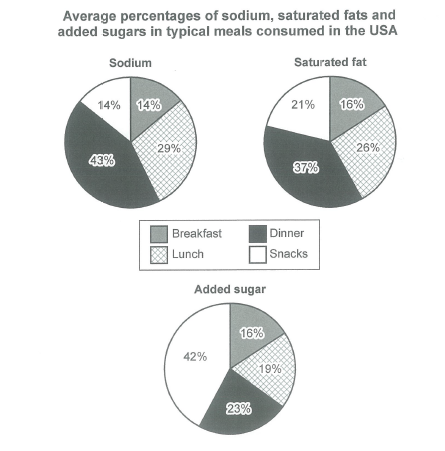
The charts below show the average percentages in typical meals of three types of nutrients, all of which may be unhealthy if eaten too much.
Summarize the information by selecting and reporting the main features, and make comparisons where relevant.
Student answer (Band 6.5)
The three pie charts demonstrates the average proportions in daily meals consumed of three types of nutrients - Sodium, Saturated fat and Added sugar - , all of which may be unhealthy if consumed too much.
Overall, saturated fat and sodium accounted a large share during dinner, while all of the three types of nutrients occupated a small proportion at Breakfast.
To begin with, the average percentages of sodium during dinner accounted for the largest share, at 43% of the total. This was followed by lunch, which represented 29%. while breakfast and snacks both accounted 14%.
Furthermore, the highest proportion of saturated fat was recorded at dinner, at 37%, followed by lunch and snacks, at 26%and 21%. In contrast, the lowest proportion goes to breakfast with 16%.
Regarding added sugar, snacks are accounted for the largest share with 42% of the total. Followed by dinner, which presented 23% and 19% recorded for. And the smallest share was accounted at breakfast with 16%.
AI examiner evaluation
| Criterion | Band |
|---|---|
| Task Achievement / Task Response | 7.0 |
| Coherence and Cohesion | 7.0 |
| Lexical Resource | 6.5 |
| Grammatical Range and Accuracy | 5.5 |
| Overall | 6.5 |
Task Achievement / Task Response: Band 7.0
You cover all three nutrients and report the main meal patterns accurately: dinner has the highest shares of sodium and saturated fat, while snacks lead for added sugar. The overview also identifies breakfast as a low-contribution meal, and the specific figures for sodium and saturated fat are correctly selected. This gives the response a clear, relevant account of the charts. However, the overview says all three nutrients occupy a small proportion at breakfast, which is a broad generalisation rather than a comparison of the most important extremes. The added-sugar paragraph is also incomplete: it gives dinner as 23% but leaves the 19% lunch figure without a clear meal label. Make that comparison explicit and sharpen the overview around the contrasting peaks.
Coherence and Cohesion: Band 7.0
The response has a clear overall progression: an introduction, an overview, and separate paragraphs for the nutrient categories. This makes the information easy to locate, and transitions such as “To begin with,” “Furthermore,” and “Regarding added sugar” help signal each section. The organisation is generally logical, with the first two categories presented in descending order. Some connections are less controlled, however. In the sodium paragraph, “while breakfast and snacks…” follows a full stop after “29%,” leaving a fragment, and the added-sugar sequence “Followed by dinner… And 19% recorded for” is difficult to follow. Use complete sentences and name each meal alongside its figure so the progression remains clear without relying on fragments.
Lexical Resource: Band 6.5
You use a suitable range of chart-reporting vocabulary, including “accounted for,” “represented,” “proportion,” and “largest share.” These choices generally communicate comparisons clearly, and the repeated use of percentage language is appropriate to the task. There are some inaccurate or awkward collocations and word forms that limit precision: “occupated a small proportion” is not a natural expression, “snacks are accounted for” uses an unsuitable form, and “presented 23%” is less idiomatic than a standard reporting verb. The phrase “the smallest share was accounted at breakfast” is also awkward. Aim for consistent, natural reporting language such as “made up,” “stood at,” or “was recorded for,” and check that each verb fits its grammatical pattern.
Grammatical Range and Accuracy: Band 5.5
You attempt a mixture of simple statements and more developed comparisons, and several sentences communicate the figures successfully. However, grammatical control is uneven, with errors in agreement, verb forms, sentence boundaries, and punctuation. For example, “The three pie charts demonstrates” has a subject–verb agreement error, while “Saturated fat and sodium accounted a large share” is missing a required preposition. The sentence beginning “while breakfast and snacks…” is incorrectly separated from the preceding sentence, and “Followed by dinner…” is a fragment. There are also inconsistent forms in “snacks are accounted for” and “the lowest proportion goes.” Practise complete sentence structures and consistent past-tense reporting; accurate control of these patterns would make the comparisons much easier to read.
See this exact question answered at other band scores. The same prompt compared across bands.
Browse more IELTS Writing model answers or get your own writing scored by the same AI examiner.