Band 6.0 IELTS Writing Task 1 Model Answer
Overall Band Score: 6.0 · Cambridge IELTS 14 · 2026-11-22
IELTS Writing Task 1 question
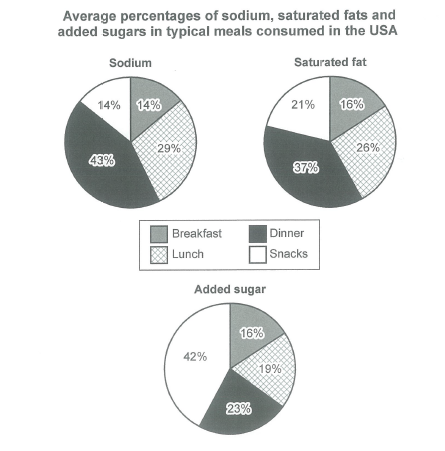
The charts below show the average percentages in typical meals of three types of nutrients, all of which may be unhealthy if eaten too much.
Summarize the information by selecting and reporting the main features, and make comparisons where relevant.
Student answer (Band 6.0)
The pie chart illustratest the average percentages of various nutrients in typical meals in the country USA which may be considered unhealthy if had in excessive quantity.
Overall, Dinner made for highest sodium and saturated fat while added sugar was found in highest proportion in snacks. Moreover, breakfast remained the meal with lowest sodium, saturated fat and added sugar levels.
Breakfast accounted for 43% of the toal sodium consumption whereas the meal with least of the amount is breakfast and snacks. Each account for 14% each. Lastly, 295 of the daily sodium intake is fulfilled from lunch.
Dinners contains the highest percentage of saturated fat which accounted for 37% whereas the breakfast accounted the least. While the remaining portion was occupied by snacks and lunch. These meals constituted for 57% of the total consumption of saturated fat.
On the other hand, snacks contains the higest amount of sugar whereas breakfast contains the least percentage of total consumption. Morever, the remaining percentage formed by breakfast and lunch which made up for 16% and 19% respectively.
AI examiner evaluation
| Criterion | Band |
|---|---|
| Task Achievement / Task Response | 6.0 |
| Coherence and Cohesion | 6.0 |
| Lexical Resource | 5.5 |
| Grammatical Range and Accuracy | 5.5 |
| Overall | 6.0 |
Task Achievement / Task Response: Band 6.0
You provide a relevant overview, correctly identifying dinner as the largest source of sodium and saturated fat and snacks as the largest source of added sugar. You also note breakfast’s low figures. However, several details are inaccurate or unclear: sodium is not 43% at breakfast; dinner accounts for 43%, while breakfast and snacks each account for 14%. “295” for lunch appears to be a mistaken rendering of 29%. The saturated-fat figures are mostly reported correctly, but the statement that breakfast is the lowest for all three nutrients overlooks that snacks tie breakfast for lowest sodium. The added-sugar paragraph gives breakfast and lunch figures but omits the important 42% for snacks and 23% for dinner. More precise reporting of these comparisons would make the coverage more complete.
Coherence and Cohesion: Band 6.0
The response has a clear overall structure: an introduction, an overview, and separate paragraphs for sodium, saturated fat, and sugar. This makes the main categories easy to follow. Linking phrases such as “Overall,” “Lastly,” and “On the other hand” help signal movement between points, although some transitions feel mechanical or do not express a clear contrast. Within the detail paragraphs, information is sometimes difficult to track because figures and comparisons are not consistently presented in a logical order; for example, the sodium paragraph begins with an incorrect breakfast figure before mentioning the lowest values. Organise each nutrient’s figures from highest to lowest, and use clearer references to meals, so the progression is more reliable and cohesive.
Lexical Resource: Band 5.5
You use a reasonable range of task-related vocabulary, including “average percentages,” “accounted for,” “proportion,” and “daily intake.” These choices show an attempt to describe data rather than simply repeat the chart labels. However, spelling and word-choice errors reduce precision, including “illustratest,” “toal,” “higest,” and “Morever.” Some expressions are also awkward or imprecise: “Dinner made for highest” and “the remaining portion was occupied by” do not sound natural in this context. Use standard collocations such as “accounted for the highest share” and “the remaining shares were.” Check spelling carefully and choose wording that clearly distinguishes a percentage of a nutrient from total daily consumption.
Grammatical Range and Accuracy: Band 5.5
You attempt both simple and more complex sentence forms, including the overview sentence beginning “Overall” and the contrast introduced by “whereas.” Most of the intended meaning can be understood, but some grammatical errors affect clarity. For example, “Dinner made for highest sodium” lacks a grammatical verb pattern, while “Dinners contains” has a subject–verb agreement error. In “the breakfast accounted the least,” the verb pattern is incomplete, and “Each account for 14% each” has an unclear subject and redundant construction. Articles and sentence boundaries also need attention. Practise accurate comparative structures such as “Dinner accounted for the highest share, whereas breakfast and snacks each accounted for the lowest.”
See this exact question answered at other band scores. The same prompt compared across bands.
Browse more IELTS Writing model answers or get your own writing scored by the same AI examiner.