Band 5.5 IELTS Writing Task 1 Model Answer
Overall Band Score: 5.5 · Cambridge IELTS 14 · 2026-11-22
IELTS Writing Task 1 question
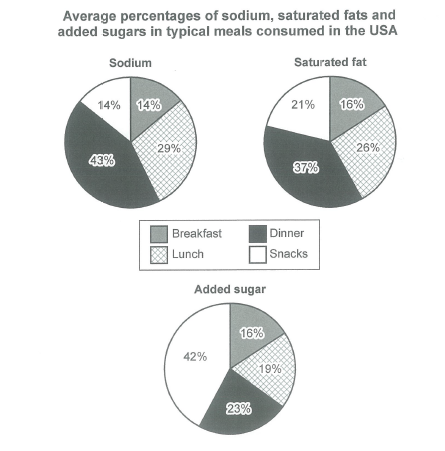
The charts below show the average percentages in typical meals of three types of nutrients, all of which may be unhealthy if eaten too much.
Summarize the information by selecting and reporting the main features, and make comparisons where relevant.
Student answer (Band 5.5)
The given three charts represents the average proportions of sodium, saturated fats and added sugars in typical meals consumed in the USA.
Overall, there are three kinds of charts such as sodium, saturated fat and added sugars in which dinner has the biggest share in sodium and almost remain stable in saturated fat, snacks has the highest proportion in added sugar.
First of all, dinner and lunch are the leading nutrients in the first chart and the ratio of breakfast and snacks remains constant. After that, in the second chart dinner and lunch has the biggest share and the proportion of snacks and breakfast remains the same.
Furthermore, in the last chart snacks are the major nutrients and dinner has also a good ratio about 23% in this chart. Whereas, the percentages of lunch and breakfast remains stable in the last chart.
Almost in all the charts dinner is the leading component. Whereas, snacks has the highest proportion in the last chart.
AI examiner evaluation
| Criterion | Band |
|---|---|
| Task Achievement / Task Response | 5.5 |
| Coherence and Cohesion | 5.0 |
| Lexical Resource | 5.5 |
| Grammatical Range and Accuracy | 5.5 |
| Overall | 5.5 |
Task Achievement / Task Response: Band 5.5
You identify the main pattern that dinner accounts for the largest shares of sodium and saturated fat, while snacks lead for added sugar. You also include some relevant figures, such as 23% for dinner’s added sugar. However, several comparisons are vague or inaccurate: breakfast and snacks do not remain constant in the saturated-fat chart (16% and 21%), and saying dinner is the leading component “in almost all the charts” overlooks that snacks lead for added sugar. The overview also calls the categories “kinds of charts” rather than summarising the meal patterns. To strengthen the report, give a clear overview and compare the key highs and lows with accurate figures across all three nutrients.
Coherence and Cohesion: Band 5.0
The response has a basic structure, moving from an introduction and overview to separate comments on the three charts. This gives the reader some sense of organisation. However, progression is limited by repeated points: dinner’s leading position is stated several times, including in the overview and conclusion, while the final sentence largely repeats earlier information. Sequencing phrases such as “First of all,” “After that,” and “Furthermore” are used mechanically and do not always clarify the comparisons. Some links, such as “Whereas,” create fragments rather than smoothly connected contrasts. Group related comparisons and use clearer references to the nutrient categories to make the report progress more logically.
Lexical Resource: Band 5.5
You use a relevant range of chart-reporting vocabulary, including “average proportions,” “biggest share,” “highest proportion,” and “percentages.” These choices generally make the topic understandable. However, some expressions are imprecise or unnatural, such as “leading nutrients” for meal categories, “good ratio” for a percentage, and “remain stable” when describing fixed values across different charts. Repetition of “biggest share” and “proportion” also limits flexibility. Choose terms that accurately describe the data, such as “meal,” “accounted for,” and “the largest share,” and vary your wording without sacrificing precision.
Grammatical Range and Accuracy: Band 5.5
You attempt both simple and more complex sentence forms, including contrasts introduced by “Whereas,” and the overall meaning is usually recoverable. However, errors in agreement and sentence construction recur. For example, “The given three charts represents” should use a plural verb, while “dinner and lunch has” and “snacks has” also show subject–verb agreement problems. “The proportion of snacks and breakfast remains the same” has a plural subject, and the “Whereas” clauses in the final paragraphs are not complete sentences. There are also awkward article and number patterns. Check each subject against its verb and connect contrast clauses to a complete main clause; this will make your comparisons clearer and more controlled.
See this exact question answered at other band scores. The same prompt compared across bands.
Browse more IELTS Writing model answers or get your own writing scored by the same AI examiner.