Band 5.5 IELTS Writing Task 1 Model Answer
Overall Band Score: 5.5 · Cambridge IELTS 14 · 2026-11-23
IELTS Writing Task 1 question
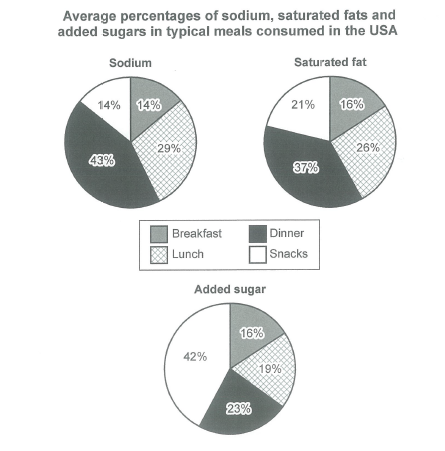
The charts below show the average percentages in typical meals of three types of nutrients, all of which may be unhealthy if eaten too much.
Summarize the information by selecting and reporting the main features, and make comparisons where relevant.
Student answer (Band 5.5)
the pie chart illustrate the percentage and three types of nutrients and meals which become a reason of unhealthy if people eat in high amount.
overall, in dinner people highly use sodiam, saturated fat and sugar everyday that becaome a reason of people unhealty and other health problems and secondly use of sugar in snack is also a reason and in lunch or breakfast people use normal amount sugar ,sodium and saturated fat.
highly use of sodium is accounted for 43% which highy people use in dinner while saturated fat represented 37% and amount of snacks which consumed 29% of sodium while breakfast consume14% of sodium and the other hand saturated fat use in snacks represented 21% while fat use breakfast is 16% and high use of fat use lunch .
people use much amount of Added sugar in snacks which represented 42% that is very harmful for become unhealthy and other use of sugar in dinner is 23% while in lunch accounted for 19% and in breakfast use 16% which same proportion as saturated fat.
AI examiner evaluation
| Criterion | Band |
|---|---|
| Task Achievement / Task Response | 5.5 |
| Coherence and Cohesion | 5.5 |
| Lexical Resource | 5.0 |
| Grammatical Range and Accuracy | 5.0 |
| Overall | 5.5 |
Task Achievement / Task Response: Band 5.5
You identify the main pattern that dinner has the highest shares of sodium and saturated fat, while snacks lead for added sugar. You also include several relevant figures, such as 43% for dinner sodium and 42% for snack sugar. However, some data are misreported: snacks account for 14% of sodium, not 29%, and 29% belongs to lunch. The overview also says dinner has the highest sugar share, although snacks are highest. The response partly describes the charts, but the inaccurate comparison and limited coverage of the overall contrasts make the key features less clear. Check each figure against the chart and state the main rankings accurately before adding detail.
Coherence and Cohesion: Band 5.5
The response has a basic structure, with an opening, an overview and separate paragraphs for nutrient details. This gives the reader some sense of how the information is grouped. However, progression within the paragraphs is difficult to follow: the sodium and fat comparisons are combined in a long sentence, and phrases such as “while” and “on the other hand” do not always make the relationships clear. The overview also repeats ideas about unhealthy effects rather than setting out the chart’s main contrasts. Use one paragraph for the overview and organise the details consistently by meal or nutrient, with shorter sentences and clear comparison links.
Lexical Resource: Band 5.0
You use relevant chart vocabulary, including “percentage,” “represented,” “accounted for” and “proportion,” and you attempt to describe comparisons. However, the range is limited and several word choices or collocations make the meaning unclear, such as “people highly use” and “amount of snacks which consumed.” Repetition of “use” and “amount” also reduces precision. There are noticeable spelling errors, including “sodiam,” “becaome” and “unhealty,” which distract from the data description. Build a more accurate set of terms for reporting proportions and rankings, and check spelling carefully. Prefer neutral descriptions of what each meal contains rather than claims about people’s habits.
Grammatical Range and Accuracy: Band 5.0
The response attempts some longer comparative sentences, but these are often difficult to follow because of errors in sentence structure and punctuation. For example, “while saturated fat represented 37% and amount of snacks which consumed 29% of sodium” does not form a complete, clear comparison. There are also recurring problems with articles, agreement and verb forms, as in “the pie chart illustrate” and “people use much amount.” Most sentences rely on simple patterns, and the longer attempts are not controlled consistently. Practise accurate subject–verb agreement and complete sentence structures, then use shorter sentences to report each figure before combining comparisons with “whereas” or “compared with.”
See this exact question answered at other band scores. The same prompt compared across bands.
Browse more IELTS Writing model answers or get your own writing scored by the same AI examiner.