Band 5.0 IELTS Writing Task 1 Model Answer
Overall Band Score: 5.0 · Cambridge IELTS 14 · 2026-11-23
IELTS Writing Task 1 question
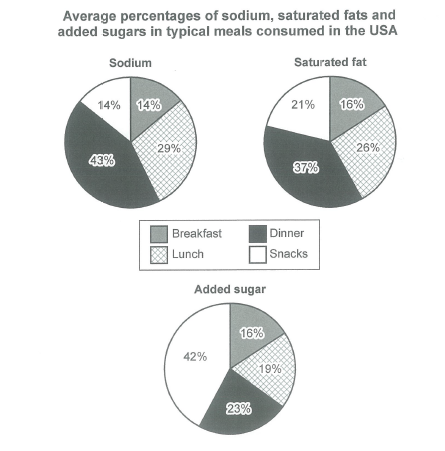
The charts below show the average percentages in typical meals of three types of nutrients, all of which may be unhealthy if eaten too much.
Summarize the information by selecting and reporting the main features, and make comparisons where relevant.
Student answer (Band 5.0)
In the chart, it show that the average percentages in three types of typical meals maybe unhealthy if it is eaten much .
Overall, there are 43% sodium in dinner and 29% in lunch rather than snacks and breakfast. On the other side, saturated fat also high in dinner 37% and lunch is less than dinner in 26%. Althrough, breakfast and snacks is in the average. However, there are high range of added suger in snacks 42% and in dinner it is less than snacks 23%.Nevertheless, lunch and breakfast is in blance level.
In the end, these three ingredients should be in a blance level for a healthy life . Otherwise it will be effects in their health . People can not eat too much while it is unhealthy for a healthy lifestyle.
AI examiner evaluation
| Criterion | Band |
|---|---|
| Task Achievement / Task Response | 5.0 |
| Coherence and Cohesion | 5.0 |
| Lexical Resource | 5.0 |
| Grammatical Range and Accuracy | 5.0 |
| Overall | 5.0 |
Task Achievement / Task Response: Band 5.0
You identify several important patterns, including dinner as the largest source of sodium (43%) and saturated fat (37%), and snacks as the largest source of added sugar (42%). However, the response only partially fulfils the chart-summary task: it gives few precise comparisons, omits some useful figures, and does not clearly compare all four meals across the nutrients. The comments that breakfast and snacks are “in the average” and that lunch and breakfast are “in balance” are vague and not supported by the data. The final advice about healthy eating is not required; use that space to report chart features instead. The response is also 17 words below the required minimum. Add a concise overview and more accurate, specific comparisons.
Coherence and Cohesion: Band 5.0
There is a basic attempt to organise the response: an opening statement is followed by comparisons and then a concluding comment. Some linking words, such as “Overall,” “However,” and “Nevertheless,” show an effort to connect ideas. However, the progression is not consistently clear, and several transitions do not express the relationship between the points accurately. For example, “On the other side” and “Althrough” interrupt rather than clarify the comparisons, while “In the end” introduces general advice instead of a useful summary. The comparisons are crowded into one paragraph, making it harder to follow which meal and nutrient each figure refers to. Group the information into a clear overview and comparison paragraphs, and use simpler, more precise links.
Lexical Resource: Band 5.0
Your vocabulary is sufficient to communicate the general topic, and terms such as “sodium,” “saturated fat,” “added sugar,” and “percentages” are relevant to the chart. However, the range is limited, and several inaccurate or misspelled expressions make the meaning less clear. “High range” is not a natural way to describe a large proportion, and “in the average” does not clearly convey a comparison. There are also spelling errors in “suger” and “blance,” and “effects in their health” is an awkward phrase. Aim for precise chart language such as “accounted for,” “proportion,” “highest,” and “lowest,” while checking spelling and choosing natural collocations.
Grammatical Range and Accuracy: Band 5.0
The response mainly uses short, simple statements, with a few attempts to join ideas using contrastive clauses. However, frequent errors in sentence structure and agreement make some sentences difficult to read. For example, “it show” needs subject–verb agreement, and “breakfast and snacks is” should use a plural verb. The opening phrase “it is eaten much” has an unclear structure, while “lunch is less than dinner in 26%” does not form a clear comparison. Punctuation also needs attention: there is no space after the full stop in “23%.Nevertheless,” and several clauses are joined awkwardly. Practise accurate simple comparisons first, then add controlled complex sentences.
See this exact question answered at other band scores. The same prompt compared across bands.
Browse more IELTS Writing model answers or get your own writing scored by the same AI examiner.