Band 4.0 IELTS Writing Task 1 Model Answer
Overall Band Score: 4.0 · Cambridge IELTS 14 · 2026-11-23
IELTS Writing Task 1 question
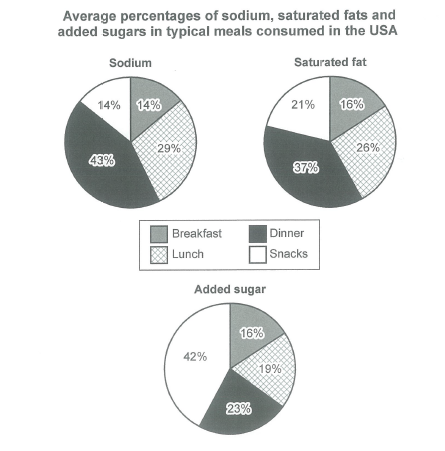
The charts below show the average percentages in typical meals of three types of nutrients, all of which may be unhealthy if eaten too much.
Summarize the information by selecting and reporting the main features, and make comparisons where relevant.
Student answer (Band 4.0)
overview: the chart shows the information three different types of meals and healthy or unhealthy when we eat too much.
to begin with sodium the breakfast was 14% in the same way snacks are same to breakfast a lot of people eat dinner to much and that was hi% as well as lunch 29 in human in l
AI examiner evaluation
| Criterion | Band |
|---|---|
| Task Achievement / Task Response | 3.0 |
| Coherence and Cohesion | 3.5 |
| Lexical Resource | 4.5 |
| Grammatical Range and Accuracy | 4.0 |
| Overall | 4.0 |
Task Achievement / Task Response: Band 3.0
The response makes a relevant start by identifying sodium and reporting that breakfast and snacks are both 14%, and it also attempts to mention lunch at 29%. However, it does not provide a clear overview of the main patterns: dinner is highest for sodium and saturated fat, while snacks lead for added sugar. The phrase “healthy or unhealthy” does not accurately summarise what the charts compare, which is nutrient percentages across meals. Most of the chart is not covered, and the final comparison is incomplete. The response is also substantially below the required 150 words. To improve, give a concise overview and report the key figures for all three nutrients, comparing the highest and lowest meal categories.
Coherence and Cohesion: Band 3.5
There is a basic attempt to organise the response: “overview” introduces a general statement, followed by “to begin with” and a focus on sodium. The comparison that breakfast and snacks are the same also gives the reader one identifiable point. However, the response stops before developing a complete sequence of information, and the final phrase, “29 in human in l,” is unfinished and difficult to follow. Connections between ideas are limited, while “in the same way” does not clearly express the intended comparison. Use separate paragraphs for the overview and details, then group the figures by nutrient and connect comparisons explicitly, for example, “By contrast” or “whereas.”
Lexical Resource: Band 4.5
The response uses a small set of relevant terms, including “sodium,” “breakfast,” “snacks,” and “29%,” so the topic is recognisable. However, the vocabulary is very limited and several choices are inaccurate or informal for an academic chart summary. “Healthy or unhealthy” misrepresents the chart’s focus, and “a lot of people eat dinner to much” introduces an unsupported claim about people’s behaviour rather than describing the data. “Hi%” and the unfinished wording at the end also make the message unclear. Build a more precise range for describing proportions and comparisons, such as “accounted for,” “highest share,” and “equal proportions,” and use the chart’s nutrient and meal labels consistently.
Grammatical Range and Accuracy: Band 4.0
The response attempts simple statements and a comparison, such as “the breakfast was 14%” and “snacks are same to breakfast,” but grammatical control is weak and sentence structures are very limited. Errors include the missing article or possessive structure in “the information three different types of meals,” the unclear construction “snacks are same to breakfast,” and the incomplete final clause. The sentence about dinner and lunch also runs together without clear punctuation, making the relationships between ideas hard to understand. Practise complete subject–verb sentences, accurate comparison patterns such as “the figure for snacks was the same as breakfast,” and punctuation that separates each data point.
See this exact question answered at other band scores. The same prompt compared across bands.
Browse more IELTS Writing model answers or get your own writing scored by the same AI examiner.