Band 6.0 IELTS Writing Task 1 Model Answer
Overall Band Score: 6.0 · Cambridge IELTS 14 · 2026-11-23
IELTS Writing Task 1 question
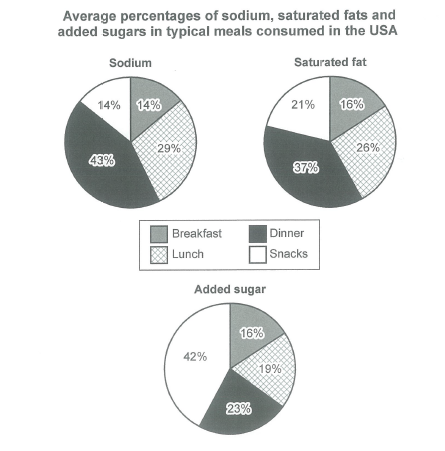
The charts below show the average percentages in typical meals of three types of nutrients, all of which may be unhealthy if eaten too much.
Summarize the information by selecting and reporting the main features, and make comparisons where relevant.
Student answer (Band 6.0)
The pie charts illustrate the average percentages of sodium, saturated fats and added sugars in typical meals consumed in the USA.
At a glance, it is clear that sodium and saturated fat was consumed most of the time in the dinner while sugar was mostly ate in the snacks.
Sodium nutrients was consumed 43% in the dinner. By contrast, 14% of it ate in the breakfast and in snacks. In addition, lunch showed 29% of its use.
Saturated fat was highly taken in the dinner accounted for 37%. In the breakfast 16% of it was consumed. However in the lunch it was taken 26% and it was used 21% in the snacks. In terms of sugar, 42% of sugar was added in the snacks. 23% of it was used in the dinner and 19% of sugar was taken at lunch. Moreover, 16% of it was consumed in the breakfast time.
AI examiner evaluation
| Criterion | Band |
|---|---|
| Task Achievement / Task Response | 7.0 |
| Coherence and Cohesion | 6.5 |
| Lexical Resource | 5.5 |
| Grammatical Range and Accuracy | 5.5 |
| Overall | 6.0 |
Task Achievement / Task Response: Band 7.0
You cover all three nutrients and all four meal categories, and the figures reported match the chart. The overview identifies the key contrast: sodium and saturated fat peak at dinner, whereas added sugar is highest in snacks. You also support this with relevant figures, including 43% sodium at dinner and 42% added sugar in snacks. This gives the response a clear, data-based account of the main features. To make the summary more fully developed, compare the distributions more directly—for example, note that dinner is also the leading meal for saturated fat, while breakfast is the lowest or joint-lowest category for several nutrients. A concise comparison across nutrients would strengthen the overview rather than mainly listing figures in sequence.
Coherence and Cohesion: Band 6.5
The response has a clear overall progression: an introduction, an overview, and then details about sodium, saturated fat and sugar. Linking expressions such as “At a glance,” “By contrast,” “In addition” and “Moreover” help signal relationships, and the reader can follow the information. However, the body is organised mainly as a sequence of nutrient-by-nutrient statements, so comparisons between the charts are limited. Some transitions, such as “However” before the lunch figure, do not express a strong contrast. To move further, group related comparisons more deliberately and use referencing consistently, so the links between figures feel less formulaic and the progression is more analytical.
Lexical Resource: Band 5.5
You use relevant topic vocabulary, including “average percentages,” “sodium,” “saturated fat” and “consumed,” so the subject is clear. However, the range of reporting language is limited, and several choices are unnatural or imprecise: “sugar was mostly ate,” “highly taken,” and “showed 29% of its use.” Repeating “consumed,” “taken” and “used” also makes the account less flexible. Choose standard chart-reporting collocations such as “accounted for,” “was highest in,” and “made up.” Be careful that “added sugar” names the nutrient shown, rather than implying sugar was added during a meal. More precise and varied phrasing would improve clarity and naturalness.
Grammatical Range and Accuracy: Band 5.5
The response uses mostly short, straightforward sentences, with a few attempts to vary structure, such as “By contrast” and “In addition.” Meaning is generally recoverable, but errors in agreement, verb forms and sentence construction are noticeable. For example, “sodium and saturated fat was consumed” needs a plural verb, while “sugar was mostly ate” has an incorrect passive form. “Sodium nutrients was consumed 43%” also has an unclear grammatical structure; a clearer pattern is “Sodium accounted for 43% at dinner.” There are also missing or awkward articles and prepositions in phrases such as “in the breakfast.” Practise accurate passive forms and use a consistent subject–verb pattern when reporting percentages.
See this exact question answered at other band scores. The same prompt compared across bands.
Browse more IELTS Writing model answers or get your own writing scored by the same AI examiner.