Band 4.5 IELTS Writing Task 1 Model Answer
Overall Band Score: 4.5 · Cambridge IELTS 14 · 2026-11-24
IELTS Writing Task 1 question
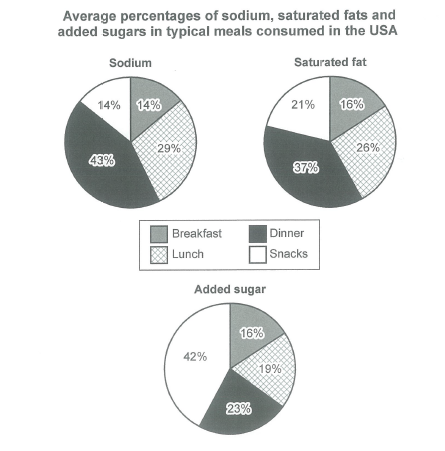
The charts below show the average percentages in typical meals of three types of nutrients, all of which may be unhealthy if eaten too much.
Summarize the information by selecting and reporting the main features, and make comparisons where relevant.
Student answer (Band 4.5)
In USA most of people consumed typical meals like added sugar in their breakfast, lunch and dinner. In provided chart we can see average percentage in all typical meals with three types of nutrients which may unhealthy if eaten too much in thier daily life or routine.
As per chart we can see average percentage of sodium, saturated fats and added sugars in typical meals consumed in the USA and this thing represnt the unhealthy lifestyle of those poeple who are consuming heavy dose of unhealthy food. Food habits also depends on the diversification of people's area where from they are living and belongs and in there area which kind of food available for consume.
Most of people consuming these factors mostly in dinner time as compared to breakfast and some people don't know about it, that these unhealthy things are putting negative impact on people health and they have to face critical circumtamces due to theses unhealthy nutrients.
AI examiner evaluation
| Criterion | Band |
|---|---|
| Task Achievement / Task Response | 4.0 |
| Coherence and Cohesion | 4.5 |
| Lexical Resource | 5.0 |
| Grammatical Range and Accuracy | 5.0 |
| Overall | 4.5 |
Task Achievement / Task Response: Band 4.0
The response recognises that the charts compare three nutrients across meals and identifies dinner as a major source, which is relevant. However, it does not adequately summarise the chart: it gives no figures and overlooks the key contrast that dinner is highest for sodium and saturated fat, while snacks are highest for added sugar. The claim that people consume added sugar in breakfast, lunch and dinner is vague and does not report the proportions. Much of the response shifts to unsupported comments about unhealthy lifestyles, food availability and health consequences rather than describing the data. To make the summary more complete, select the main highs and lows, support them with accurate percentages, and keep the discussion focused on what the charts show.
Coherence and Cohesion: Band 4.5
There is some basic organisation: the response has separate paragraphs and moves from an introduction to general comments about the chart and then to a comparison involving dinner. However, the ideas do not develop in a clear sequence, and the second paragraph repeats the chart’s subject instead of adding a distinct feature. Linking phrases such as “As per chart” and “Most of people” do not create clear relationships between points, while the discussion of food availability interrupts the data summary. A clearer progression would be to give an overview first, then group the meal comparisons—for example, dinner’s high sodium and fat figures versus snacks’ high sugar figure—and use concise references to connect those details.
Lexical Resource: Band 5.0
The response uses some task-related vocabulary, including “average percentage,” “sodium,” “saturated fats” and “added sugars,” so the topic is generally identifiable. However, the range is limited and several phrases are imprecise or unnatural, such as “heavy dose of unhealthy food,” “factors” for nutrients, and “critical circumtamces.” Spelling errors including “thier,” “represnt” and “poeple” also make the writing less clear. Some wording is repetitive, particularly repeated references to “unhealthy” food and nutrients. Aim for precise chart language such as “accounted for” or “the proportion of,” and check spelling and collocations so the reader can understand the comparisons without effort.
Grammatical Range and Accuracy: Band 5.0
The response attempts both simple and longer sentence forms, but control is inconsistent and errors occur frequently enough to make some sentences difficult to follow. For example, “In USA most of people consumed typical meals” has problems with articles and the noun phrase, while “which may unhealthy” is missing a verb. In “Food habits also depends,” the subject and verb do not agree, and “where from they are living and belongs” has an unclear, faulty clause structure. The final sentence also combines several ideas without clear grammatical control. Practise accurate basic sentence patterns first, then build longer comparisons using clauses such as “Dinner accounts for…” and “By contrast, snacks contribute…”.
See this exact question answered at other band scores. The same prompt compared across bands.
Browse more IELTS Writing model answers or get your own writing scored by the same AI examiner.