Band 5.0 IELTS Writing Task 1 Model Answer
Overall Band Score: 5.0 · Cambridge IELTS 14 · 2026-11-25
IELTS Writing Task 1 question
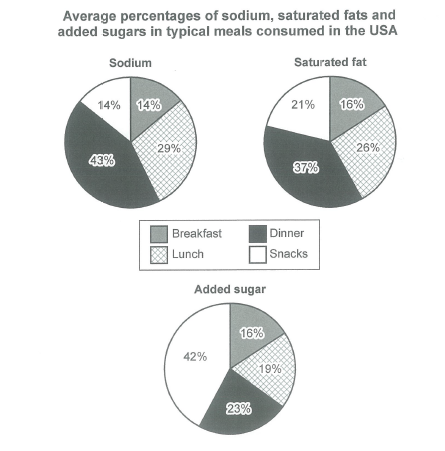
The charts below show the average percentages in typical meals of three types of nutrients, all of which may be unhealthy if eaten too much.
Summarize the information by selecting and reporting the main features, and make comparisons where relevant.
Student answer (Band 5.0)
The charts illustrate the three different percentages of sodium, saturated fats and added sugar in meals used in USA.
Overall it is clear that, the percentage of sugar is maximum that consumed in USA meals like in snacks, while the sodium is minimum use in snakes and breakfast. The sodium in dinner is slightly high percentage then other.
The sugar used about 42% in snacks while tje 43% sodium in dinner and the saturated fats 37% in dinner. Sofium in equal amount 14% in both breakfast and snacks, while the saturated fats 21 percent in snacks and 16 percent in breakfast in addition the sugar added about 16% in breakfast. Sugar added 19% in luch while 26 in saturated fats and 29% in sodium. Saturated fats added in dinner almost 23% ,while in sodium 43 percent and sugar 23 percentage that used in USA food in lunch, dinner, breakfast and in snacks
AI examiner evaluation
| Criterion | Band |
|---|---|
| Task Achievement / Task Response | 5.5 |
| Coherence and Cohesion | 4.0 |
| Lexical Resource | 5.0 |
| Grammatical Range and Accuracy | 4.5 |
| Overall | 5.0 |
Task Achievement / Task Response: Band 5.5
You identify the three nutrients and report several relevant figures, including sodium at 43% in dinner, added sugar at 42% in snacks, and saturated fat at 37% in dinner. However, the overview is unclear and partly inaccurate: sodium is not at its minimum only in “snakes and breakfast” as written; it is equal at 14% in breakfast and snacks. The claim that dinner has the highest sodium is correct, but the main contrast—that added sugar peaks in snacks while sodium and saturated fat peak at dinner—could be stated more clearly. Some comparisons are confused, especially the final sentence, which assigns figures to meals unclearly. Select the key patterns and report each comparison accurately and explicitly.
Coherence and Cohesion: Band 4.0
The response has an opening, an overview, and a body paragraph, so there is an attempt to organise the information. However, ideas do not progress clearly within these sections. The overview moves from sugar to sodium without a precise comparison, and the final paragraph shifts repeatedly between meals and nutrients. For example, “Sugar added 19% in luch while 26 in saturated fats and 29 in sodium” makes the relationships difficult to follow. Linking words such as “while” and “in addition” are used, but they do not consistently clarify how the figures relate. Group the information by meal or by nutrient, and use clear sentence patterns to make each comparison easy to track.
Lexical Resource: Band 5.0
You use relevant topic vocabulary, including “sodium,” “saturated fats,” “percentage,” and “snacks,” which helps keep the response focused on the chart. However, the range is limited and several word choices or spelling errors make parts difficult to understand: “snakes” appears where “snacks” is intended, “Sofium” is unclear, and “used in USA meals” is not a natural way to describe the data. Repeated use of “used” and “added” also limits precision. Choose standard chart language such as “accounted for,” “made up,” or “the proportion of,” and check spelling carefully. More accurate collocations would make your comparisons clearer without requiring unusually advanced vocabulary.
Grammatical Range and Accuracy: Band 4.5
You attempt both simple and longer sentences, but control is inconsistent, and several sentence structures make the data relationships hard to interpret. For example, “Overall it is clear that, the percentage of sugar is maximum that consumed in USA meals” has an awkward clause structure and missing grammatical elements. In “The sugar used about 42% in snacks,” the sentence lacks a suitable verb construction, while the final sentence joins several comparisons without clear boundaries. Articles, prepositions, and punctuation are also unreliable, as in “in USA food” and the comma placement after “clear that.” Practise complete subject–verb sentences and use one main comparison per sentence, with accurate articles and punctuation.
See this exact question answered at other band scores. The same prompt compared across bands.
Browse more IELTS Writing model answers or get your own writing scored by the same AI examiner.