Band 5.5 IELTS Writing Task 1 Model Answer
Overall Band Score: 5.5 · Cambridge IELTS 14 · 2026-11-25
IELTS Writing Task 1 question
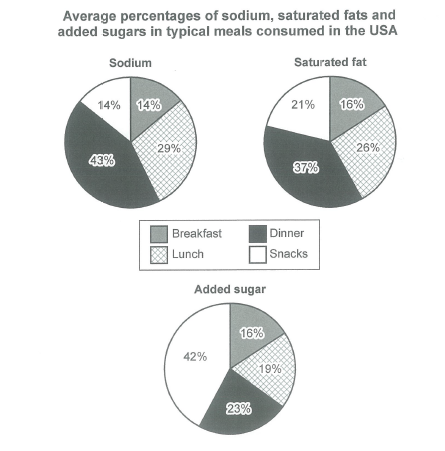
The charts below show the average percentages in typical meals of three types of nutrients, all of which may be unhealthy if eaten too much.
Summarize the information by selecting and reporting the main features, and make comparisons where relevant.
Student answer (Band 5.5)
The pie chart elucidates the findings of a survey on food consumed in the USA contains average data of sodium, saturated fats and added sugars on their preferable food such as breakfast, lunch, dinner and snacks.
A cursory glance at the graph is adequate enough to see that most consumed part of saturated fats and sodium is in dinner while snacks belongs to added sugar the most. The other half belongs to lunch of three different parts of sodium, saturated fats and added sugar which is second most consumed item. After Lunch, for sodium breakfast is the lesser amount used which is the lowest 14%. The other quarter is shared with snacks at 14%.
In summing up, it is interesting to see that the proportion is similar in dinner and lunch 43 and 37% respectively. While the lunch shared sodium saturated fats and added sugar 29%,26% and 19% respectively. Another outstanding fact is that snacks is less with sodium and saturated fats, but sugar is on far outnumber the other portions.
AI examiner evaluation
| Criterion | Band |
|---|---|
| Task Achievement / Task Response | 5.5 |
| Coherence and Cohesion | 5.5 |
| Lexical Resource | 5.5 |
| Grammatical Range and Accuracy | 5.0 |
| Overall | 5.5 |
Task Achievement / Task Response: Band 5.5
You identify the main pattern that dinner has the highest shares of sodium and saturated fat, while snacks lead for added sugar, and you include several relevant figures, such as 43%, 37%, and 42%. However, the account is only partly complete: the overview is imprecise, and some comparisons are unclear or inaccurate. For example, calling lunch the “second most consumed item” does not specify that this applies to sodium and saturated fat, and the claim that lunch is similar to dinner is not supported by the figures. You also omit the key contrast that breakfast is lowest for saturated fat and added sugar, while sodium is tied lowest in breakfast and snacks. Organise the main features more precisely and report comparisons across all three nutrients.
Coherence and Cohesion: Band 5.5
The response has a basic progression from an introduction to observations and a concluding summary, and phrases such as “After Lunch” and “In summing up” signal movement between points. However, the overall progression is not consistently clear: the second paragraph shifts between nutrients and meals without a stable comparison pattern, and the final paragraph repeats figures already mentioned rather than drawing the main comparisons together. Some linking is awkward or unclear, particularly “The other half belongs to lunch” and “The other quarter is shared with snacks,” where the reader must infer what the fractions refer to. Group the information by nutrient or by meal, and use explicit references such as “For sodium” and “By contrast, added sugar…” to make relationships easier to follow.
Lexical Resource: Band 5.5
You attempt a range of formal and descriptive vocabulary, including “elucidates,” “cursory glance,” and “outstanding fact,” and the topic is generally recognisable. However, several choices are unnatural or imprecise for describing chart data, which sometimes makes the meaning difficult to follow. For instance, “food consumed … contains average data” and “most consumed part” do not clearly express proportions, while “sugar is on far outnumber the other portions” is not an appropriate collocation. Prefer straightforward, accurate chart language such as “shows,” “proportion,” “accounted for,” and “was considerably higher.” More precise vocabulary would help you describe the figures without relying on elaborate phrases that do not fit the context.
Grammatical Range and Accuracy: Band 5.0
You attempt both simple and more complex sentence forms, including a relative clause in “all of which…”-style phrasing and a contrast introduced by “While.” However, complex constructions are often faulty, and errors frequently make relationships between ideas hard to interpret. The opening sentence lacks a clear grammatical structure (“The pie chart … contains average data”), and “snacks belongs” has subject–verb disagreement. The final clause, “sugar is on far outnumber the other portions,” is also grammatically incomplete. Sentence boundaries and punctuation need attention: the sentence beginning “While the lunch…” is a fragment. Build shorter, complete sentences first, checking subject–verb agreement and clause structure, then add more complex comparisons once those patterns are secure.
See this exact question answered at other band scores. The same prompt compared across bands.
Browse more IELTS Writing model answers or get your own writing scored by the same AI examiner.