Band 5.5 IELTS Writing Task 1 Model Answer
Overall Band Score: 5.5 · Cambridge IELTS 14 · 2026-11-25
IELTS Writing Task 1 question
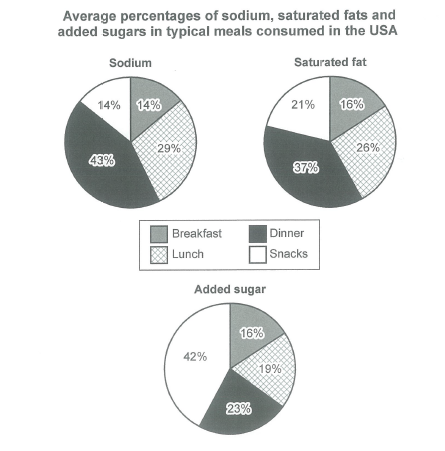
The charts below show the average percentages in typical meals of three types of nutrients, all of which may be unhealthy if eaten too much.
Summarize the information by selecting and reporting the main features, and make comparisons where relevant.
Student answer (Band 5.5)
the given charts illustrate and defect the percentage of their daily intake of virious nutrients, the ordinary American consume in each male and in snacks. these nutrients may be unhealthy taken beyond the limits.
it is fairly evident from the first pie chart which represents the consumption of sodium that maximum amount of sodium is being consumed in dinner with 43% while other one is consumed by lunch with a bit less percentage then 1/3 of it. futhermore, breakfast and snacks contains minimal amount of sodium which is 14% in both.
As it is crystal clear from the second chart which points out the conception of saturated fat as dinner contain the highest consumption with 37%. whereas, lunch and snacks compress 21% and 26% as per the chart. additionally average person in USA consumed only 16% by saturated fat in break fast. in addition to, the third chart provided information about added sugar the maximum quantity of consumption of sugar is done snacks which is 42% however dinner also contains 23% sugar in the chart while breakfast and lunch have a less percent of people who consumed added sugar why these which is respectively 16% and 19% each.
AI examiner evaluation
| Criterion | Band |
|---|---|
| Task Achievement / Task Response | 5.5 |
| Coherence and Cohesion | 5.5 |
| Lexical Resource | 5.0 |
| Grammatical Range and Accuracy | 5.0 |
| Overall | 5.5 |
Task Achievement / Task Response: Band 5.5
You identify several important features, including dinner as the largest source of sodium and saturated fat, and snacks as the largest source of added sugar. Most figures are reported accurately, such as sodium at 43% for dinner and 14% for both breakfast and snacks. However, there is a factual error in the saturated-fat comparison: lunch is 26% and snacks are 21%, but these are reversed in your response. The report also lacks a clear overall summary bringing together the main contrasts across all three charts; instead, it describes each chart in turn. To strengthen the response, add a concise overview and check each comparison against the data before reporting it.
Coherence and Cohesion: Band 5.5
The response has a basic sequence: it introduces the charts and then discusses sodium, saturated fat and added sugar in separate sections. This makes the general subject and the order of discussion understandable. However, there is no distinct overview, and the long final sentence combines several added-sugar comparisons, making the information harder to follow. Some linking expressions, such as “furthermore,” “whereas” and “in addition to,” are used mechanically or do not connect the clauses smoothly. Use clearer paragraphing, give the main overall pattern before the details, and divide long sentences so each comparison is easy to identify. More precise references to the meal categories would also improve flow.
Lexical Resource: Band 5.0
You attempt a range of vocabulary for describing charts, including “maximum amount,” “consumption” and “quantity,” but several choices are inaccurate or unnatural and sometimes make the meaning difficult to interpret. For example, “defect” does not express what the charts show, “conception” is not the right word for consumption, and “compress” is unsuitable for describing percentages. There are also noticeable spelling errors, including “virious” and “futhermore.” Repeated use of “consumption” and “contains” limits precision. Build a reliable set of chart-reporting phrases, such as “accounts for,” “is highest in,” and “the proportion of,” and check spelling and collocations carefully.
Grammatical Range and Accuracy: Band 5.0
The response attempts longer sentences and uses some subordinate clauses, but the structures are often faulty, and errors occur throughout. For example, “the ordinary American consume” has a subject–verb agreement problem, while “breakfast and snacks contains” also needs a plural verb. Several clauses are joined without clear punctuation, as in the final sentence beginning “the maximum quantity of consumption of sugar.” Articles, sentence boundaries and verb forms are also inconsistent. These errors sometimes make relationships between ideas difficult to follow. Practise writing shorter, complete comparison sentences first, then combine them with accurate connectors; check agreement and punctuation in each sentence.
See this exact question answered at other band scores. The same prompt compared across bands.
Browse more IELTS Writing model answers or get your own writing scored by the same AI examiner.