Band 5.5 IELTS Writing Task 1 Model Answer
Overall Band Score: 5.5 · Cambridge IELTS 14 · 2026-11-26
IELTS Writing Task 1 question
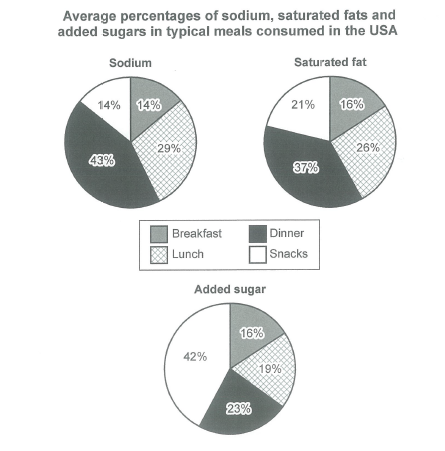
The charts below show the average percentages in typical meals of three types of nutrients, all of which may be unhealthy if eaten too much.
Summarize the information by selecting and reporting the main features, and make comparisons where relevant.
Student answer (Band 5.5)
The given charts compare the data regarding average percentage in typical meals taken in USA in three types of nutrients and it might be unhealthy if consumed in more quantity.
Overall, Dinner has the highest percentage of sodium about 43% and added sugar have the lowest percentage about 23%. Lunch again have the highest percentage of sodium and added sugar have the lowest percentage.
In USA breakfast have about 14% sodium. While saturated fat and added sugar are in same percentage in both case which is 16%. Lunch contain 29% of sodium and 26% of saturated fat and have the least percentage of added sugar about 19%.
Dinner have the highest percentage of sodium from comparing to all three about 43% and added sugar have the lowest precentage which is 23% while saturated fat is 37%. Snacks have 42% of added sugar which is highest among them and 14% of sodium in it aand 21% of saturated fat.
AI examiner evaluation
| Criterion | Band |
|---|---|
| Task Achievement / Task Response | 5.5 |
| Coherence and Cohesion | 5.5 |
| Lexical Resource | 5.5 |
| Grammatical Range and Accuracy | 5.0 |
| Overall | 5.5 |
Task Achievement / Task Response: Band 5.5
You identify several important figures, including dinner’s 43% sodium and snacks’ 42% added sugar, and you make some comparisons across meals. However, the overview is unclear and partly inaccurate: it says lunch has the highest sodium, although dinner does, and calls added sugar the lowest at 23%, when lunch is lower at 19%. The overview also repeats this claim rather than summarising the main pattern across all three nutrients. Your body includes useful details for breakfast, lunch, dinner and snacks, but the account is not consistently accurate or well-selected. To strengthen the response, give a concise overview of the contrasting peaks—dinner for sodium and saturated fat, snacks for added sugar—and check each comparison against the chart.
Coherence and Cohesion: Band 5.5
The response has a basic structure, with an introduction, an overview and separate discussion of meals, so the reader can follow the general topic. However, progression is weakened by repetition: the overview says lunch has the highest sodium and lowest added sugar, then the dinner paragraph repeats the claim that added sugar is lowest. The sequence also moves from breakfast to lunch, dinner and snacks without consistently comparing the same nutrients, which makes the main patterns harder to see. Linking is limited, and the opening “While” creates a fragment rather than a complete connected sentence. Organise the body around the key trends or compare each meal systematically, and use clear links such as “by contrast” where the data differ.
Lexical Resource: Band 5.5
You use relevant chart vocabulary such as “percentage,” “sodium,” “saturated fat” and “added sugar,” which makes the subject clear. The range is nevertheless limited, with repeated use of “highest,” “lowest” and “percentage,” and some word choices or collocations are awkward, including “data regarding average percentage” and “from comparing to all three.” There are also spelling errors, such as “precentage,” which reduce accuracy. Aim for more precise reporting language and vary how you describe values and comparisons—for example, “accounted for,” “stood at” and “exceeded.” Check spelling and use natural combinations such as “the proportion of sodium in dinner” rather than “percentage of sodium in it.”
Grammatical Range and Accuracy: Band 5.0
The response mainly uses simple statements and attempts a few longer structures, but control is inconsistent. Agreement errors appear in “Dinner has” when describing the chart generally, “added sugar have,” and “Lunch contain”; these subjects require appropriate verb forms. Articles and sentence construction are also problematic in “in same percentage in both case,” while “While saturated fat and added sugar are…” is an incomplete sentence in this context. The sentence beginning “Dinner have…” combines several ideas without clear grammatical control. Use complete sentences, check singular and plural agreement, and practise joining comparisons with conjunctions or semicolons. A wider range of accurately controlled sentence patterns would make the data easier to understand.
See this exact question answered at other band scores. The same prompt compared across bands.
Browse more IELTS Writing model answers or get your own writing scored by the same AI examiner.