Band 5.5 IELTS Writing Task 1 Model Answer
Overall Band Score: 5.5 · Cambridge IELTS 14 · 2026-11-26
IELTS Writing Task 1 question
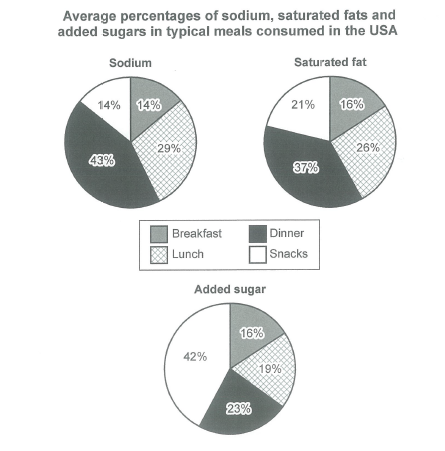
The charts below show the average percentages in typical meals of three types of nutrients, all of which may be unhealthy if eaten too much.
Summarize the information by selecting and reporting the main features, and make comparisons where relevant.
Student answer (Band 5.5)
The below charts shows some information related to three types of nutrients named sodium, saturated fat and added sugar. The data tells us about the quantity of these nutrients in three times meals and snacks in USA.
As these nutrients are considered unhealthy if taken in too much quantity. Two of the nutrients, sodium and saturated fat, are used in dinner in higher quantity than the breakfast, lunch and snacks. Added sugar is more in the snacks than others. If we compare the nutrients value in breakfast, these are almost same (14-16%). The addition of sodium and saturated fat are approximately close to each other during lunch than the added sugar(19%). The highetand lowest quantity added in the meal is sodium, dinner (43%) and snacks and breakfast (14%).
These nutrients are considered bad for human body because sugar causes insulin resistance, a condition known as diabetes mellitus. Higher sodium in the meal may cause hypertension while saturated fats leads to obesity.
AI examiner evaluation
| Criterion | Band |
|---|---|
| Task Achievement / Task Response | 5.5 |
| Coherence and Cohesion | 5.5 |
| Lexical Resource | 6.0 |
| Grammatical Range and Accuracy | 5.5 |
| Overall | 5.5 |
Task Achievement / Task Response: Band 5.5
You identify the three nutrients and report the main contrast that sodium and saturated fat peak at dinner, while added sugar is highest in snacks. The breakfast comparison is also broadly accurate. However, the overview and comparisons are incomplete: the response does not clearly compare all three nutrients across the four meal types, and the statement that the “highetand lowest quantity” is sodium at dinner and at breakfast/snacks is unclear and omits that added sugar reaches 42% in snacks. The health effects in the final lines are not requested and take space from describing the chart. A clearer overview and accurate selection of key highs and lows would make the report more complete.
Coherence and Cohesion: Band 5.5
The response has a basic progression from introducing the charts to comparing meal patterns and then adding a concluding comment. This gives the reader some organisation, and phrases such as “If we compare” signal a shift to a specific comparison. However, the middle section combines several points in a way that is difficult to follow, particularly “The highetand lowest quantity added in the meal is sodium, dinner (43%) and snacks and breakfast (14%).” The final health-effects paragraph also interrupts the chart summary rather than developing its progression. Use separate paragraphs for the overview and selected comparisons, and connect each comparison clearly; avoid relying on broad transitions when the relationship between figures is not explicit.
Lexical Resource: Band 6.0
You use relevant topic vocabulary, including “sodium,” “saturated fat,” “added sugar,” and “quantity,” and the reader can generally understand the intended comparisons. There are also attempts at more formal phrasing, such as “considered unhealthy” and “approximately close.” However, several choices are inaccurate or unnatural for describing chart data: “three times meals” should be “three meals,” “used in dinner” is not an appropriate collocation, and “addition” does not mean the amount of a nutrient. “The highetand lowest” contains a spelling/typing problem that obscures the meaning. Prefer precise reporting language such as “accounted for,” “proportion,” and “highest share,” and check spelling and collocations.
Grammatical Range and Accuracy: Band 5.5
You attempt both simple and more complex sentence forms, including a conditional comparison beginning “If we compare” and a reason clause with “because.” The main ideas are usually understandable, but some grammatical errors remain. The opening has subject–verb disagreement in “The below charts shows,” and “As these nutrients are considered unhealthy…” is a dependent clause presented as a sentence. In “Higher sodium in the meal may cause hypertension while saturated fats leads to obesity,” the plural subject “fats” does not agree with “leads.” Articles and sentence construction also need attention in phrases such as “in three times meals.” Build accuracy by checking agreement and ensuring each sentence has a complete main clause; vary structures while keeping comparisons clear.
See this exact question answered at other band scores. The same prompt compared across bands.
Browse more IELTS Writing model answers or get your own writing scored by the same AI examiner.