Band 5.5 IELTS Writing Task 1 Model Answer
Overall Band Score: 5.5 · Cambridge IELTS 14 · 2026-11-27
IELTS Writing Task 1 question
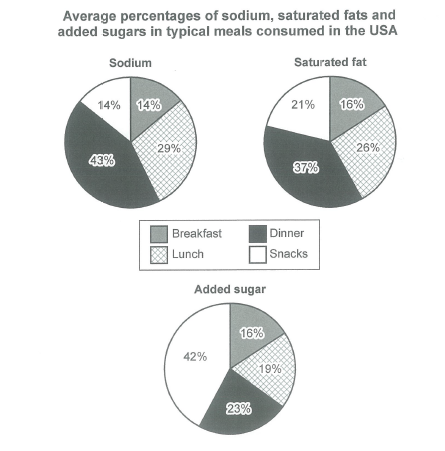
The charts below show the average percentages in typical meals of three types of nutrients, all of which may be unhealthy if eaten too much.
Summarize the information by selecting and reporting the main features, and make comparisons where relevant.
Student answer (Band 5.5)
The below 3 pie charts show the amount of nutrients(sodium, saturated fat and added sugar) that are supposed to be unhealty if the inatake of these nutrients are too much.
Overall, the people of USA consumed the unhealty nutrients mostly in dinner whereas, the least number of nutrients are consumed in the breakfast.
The people of USA has consumed sodium 14% in snacks while, saturated fat are consumed 21% and added sugar intake is 42% in snacks respectively. In breakfast, 14% of sodium is cosumed meanwhile the intake of saturated fat and added sugar is 16%.
People has consumed 29% of sodium in lunch while, saturated fat was consumed 26% and 19% of added sugar is consumed. Most of these unhealthy nutrients were consumed mostly in dinner. sodium was consumed 43% by the people of USA while, saturated fat is consumed 37% and the added sugar intake is less if we compares with the intake of sodium and saturated fat, the intake for the added sugar is 23%.
AI examiner evaluation
| Criterion | Band |
|---|---|
| Task Achievement / Task Response | 6.0 |
| Coherence and Cohesion | 5.5 |
| Lexical Resource | 5.0 |
| Grammatical Range and Accuracy | 5.0 |
| Overall | 5.5 |
Task Achievement / Task Response: Band 6.0
You cover all four meal categories and report the figures accurately, including dinner’s highest sodium and saturated-fat shares (43% and 37%) and snacks’ highest added-sugar share (42%). Your overview identifies dinner as the main source overall, but saying breakfast has “the least number of nutrients” is unclear: the charts show percentages of each nutrient, and breakfast ties with snacks for the lowest sodium share. The overview would be more precise if it highlighted the contrasting peaks—dinner for sodium and saturated fat, snacks for added sugar—and noted that breakfast is generally low. The final comparison of dinner’s added sugar with its other nutrients is relevant, though the main features could be selected and summarised more clearly rather than repeated in several sentences.
Coherence and Cohesion: Band 5.5
The response has a recognisable structure: an introduction, an overview, and paragraphs covering snacks, breakfast, lunch and dinner. This makes the information broadly easy to locate. However, the progression is somewhat mechanical, with repeated openings such as “The people of USA…” and repeated use of “while.” The overview’s claim about the “least number of nutrients” also makes the comparison difficult to follow. Grouping the data by the most important patterns—for example, dinner’s high sodium and saturated fat versus snacks’ high added sugar—would create a clearer progression. Use linking phrases selectively, and make references such as “these unhealthy nutrients” more specific so readers can follow exactly which figures are being compared.
Lexical Resource: Band 5.0
You use relevant topic vocabulary, including “sodium,” “saturated fat,” “added sugar,” “intake” and “consumed,” so the subject is clear. However, the range is limited and several words or phrases are repeated, particularly “consumed” and “intake.” Some choices are imprecise for describing chart data: “the least number of nutrients” refers to a count rather than a percentage, and “amount” is less exact than “proportion” or “share.” Spelling errors such as “unhealty,” “inatake” and “cosumed” are noticeable and reduce accuracy. Aim for a small range of precise reporting verbs and nouns, and check spelling carefully; this would make the description more natural and exact.
Grammatical Range and Accuracy: Band 5.0
You attempt both simple and longer sentences, and the reader can generally understand the comparisons. However, errors in agreement, articles and sentence construction occur often enough to make some sentences awkward. For example, “The people of USA has consumed” has a subject–verb agreement error, while “People has consumed” repeats the problem. In “saturated fat are consumed,” the singular noun does not agree with the verb. Several clauses are joined with commas and “while,” creating unclear or incomplete punctuation, as in the snacks sentence. Practise forming accurate comparison sentences with a clear subject and verb, and check agreement and punctuation when joining clauses. More reliable control of these patterns would improve clarity.
See this exact question answered at other band scores. The same prompt compared across bands.
Browse more IELTS Writing model answers or get your own writing scored by the same AI examiner.