Band 5.0 IELTS Writing Task 1 Model Answer
Overall Band Score: 5.0 · Cambridge IELTS 14 · 2026-11-27
IELTS Writing Task 1 question
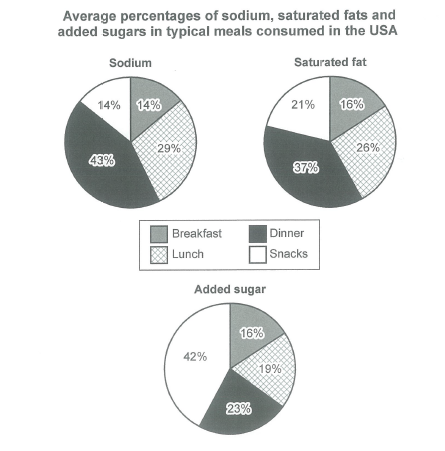
The charts below show the average percentages in typical meals of three types of nutrients, all of which may be unhealthy if eaten too much.
Summarize the information by selecting and reporting the main features, and make comparisons where relevant.
Student answer (Band 5.0)
The pie chart illustrtes the average percentage in typical meals of three type of nutrients which are unhealthy for us if we eat too much.
Overall, the percentage of dinner was on its peak in sodium and then graually declined and the snacks in sodium is about 15 percent but with time it is increased.
If we start from the dinner which is about 43% in sodium and gradually decreased and in saturated fat it becomes about 37% and in the sugar it was at 23% and if we look at the snacks area which is about 14% in sodium section, gradually increased and in saturated fat it will becomes about 21% and then at the end in the sugar it was about 42% which is too much as compared to others.
Now if we look at the breakfast and lunch which is in sodium 14% with 29% then in saturated fat the breakfast was increased 2percent and becomes from 14% to 16% and in fat the lunch is declined 3percent and becomes 26% which was 29% in sodium and now if we talk about the sugar the breakfast was same as we see in the saturated fat 16% but the lunch was at its declined point with 19% low as compared to the sodium and saturated section.
At the end these are the meals which was consumed in usa at their increasing level which now declined and stable.
AI examiner evaluation
| Criterion | Band |
|---|---|
| Task Achievement / Task Response | 5.0 |
| Coherence and Cohesion | 4.5 |
| Lexical Resource | 5.0 |
| Grammatical Range and Accuracy | 5.0 |
| Overall | 5.0 |
Task Achievement / Task Response: Band 5.0
You identify the three nutrients and report several relevant figures, including dinner’s 43% share of sodium and snacks’ 42% share of added sugar. However, the response only partially summarises the chart: it does not clearly compare the overall patterns across all four meals, and the overview is unclear. The statement that dinner’s percentage “gradually declined” and snacks’ share “with time… increased” suggests a time trend, although the chart compares meal types rather than changes over time. Some comparisons are also difficult to follow, such as describing lunch’s sugar figure as “declined” without explaining the comparison. Focus the overview on the main contrasts: dinner is highest for sodium and saturated fat, while snacks are highest for added sugar.
Coherence and Cohesion: Band 4.5
There is some organisation into an introduction, an overview and two detail paragraphs, and phrases such as “Overall” and “Now if we look at” signal movement between points. However, the progression is not consistently clear: the second paragraph moves from dinner to snacks and across nutrients, while the next shifts between breakfast, lunch and comparisons without a stable pattern. Repeated sequencing phrases and “and then” make the writing feel mechanical, and references such as “it” and “this” are sometimes unclear. Group the information by meal or by nutrient, and use direct comparisons to connect the figures. A concise overview followed by two logically grouped detail paragraphs would make the chart easier to follow.
Lexical Resource: Band 5.0
Your vocabulary is sufficient to name the chart’s main categories and communicate basic comparisons, using terms such as “percentage,” “sodium,” “saturated fat” and “declined.” However, the range is limited and several choices are inaccurate or awkward for describing static chart data. “On its peak” and “increased” imply a time-based change, while “the snacks area” is not a natural way to refer to a meal category. There are also noticeable spelling errors, including “illustrtes” and “graually,” which reduce precision. Use more exact chart language such as “accounted for,” “recorded the highest proportion” and “was followed by,” and check spelling before submitting.
Grammatical Range and Accuracy: Band 5.0
You attempt longer sentences and use some linking clauses, but the range is limited and complex sentences are often difficult to control. For example, “if we start from the dinner which is about 43% in sodium and gradually decreased” has an incomplete and confusing structure, while “it will becomes” combines incompatible verb forms. Agreement and articles are also inconsistent, as in “these are the meals which was consumed” and “the percentage of dinner.” Several sentences run on, making relationships between figures hard to understand. Practise writing shorter, complete comparison sentences, and check subject–verb agreement, tense consistency and sentence boundaries. For example: “Dinner accounted for 43% of sodium, compared with 37% of saturated fat and 23% of added sugar.”
See this exact question answered at other band scores. The same prompt compared across bands.
Browse more IELTS Writing model answers or get your own writing scored by the same AI examiner.