Band 4.5 IELTS Writing Task 1 Model Answer
Overall Band Score: 4.5 · Cambridge IELTS 14 · 2026-11-28
IELTS Writing Task 1 question
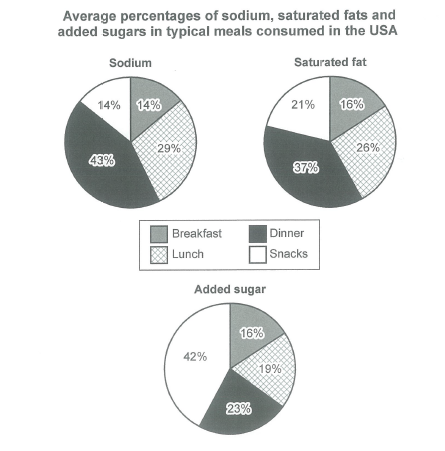
The charts below show the average percentages in typical meals of three types of nutrients, all of which may be unhealthy if eaten too much.
Summarize the information by selecting and reporting the main features, and make comparisons where relevant.
Student answer (Band 4.5)
The diagram illustrate the average percentage in typical meals of three types of nutrients all of which may unhealthy if eaten to much.
Overall it is clear that in sodium and saturated fat dinner is shown maximum in dinner, whereas in added sugar the breakfast were minimum.
Fatching into details, it is clear that dinner is the higher in sodium accounted at 43% followed by in satured fat dinner is decreae up to 6%and in added sugar it again decrease up to 14%. and when it come on snakes and brakfast in sodium same accounted at 14% and in satured fat snakes increasd 6% and brekfast increase up to 2% followed by in added sugar break fast again increase up to 6% and isnakes rose up to 27%.
Considiring the remaining details the dinner is the greater nutrients and other were minimum followed by lunch in sodium 29 and when it come on saturatedfatit drop up to 3% and in added sugar again drop up to 3%
AI examiner evaluation
| Criterion | Band |
|---|---|
| Task Achievement / Task Response | 4.5 |
| Coherence and Cohesion | 5.0 |
| Lexical Resource | 4.5 |
| Grammatical Range and Accuracy | 4.5 |
| Overall | 4.5 |
Task Achievement / Task Response: Band 4.5
You identify a relevant overall contrast: dinner has the highest shares of sodium and saturated fat, while added sugar is most prominent in snacks. However, the overview also says breakfast is the minimum for added sugar, which is inaccurate: breakfast is 16%, whereas snacks are 42% and dinner is the lowest at 23% only if comparing? In fact, the chart shows breakfast 16%, so it is the minimum. Several later comparisons are unclear or misreported: for example, “in added sugar it again decrease up to 14%” does not match the figures, and the account of lunch gives changes rather than clearly reporting its values. The response selects some key features but does not describe the chart reliably or clearly enough. State the main values and comparisons directly, avoiding unexplained percentage-point changes.
Coherence and Cohesion: Band 5.0
The response has a basic paragraph structure, with an introduction, an overview and two detail paragraphs, and it attempts to group information by meal and nutrient. This gives the reader some sense of organisation. However, progression is difficult to follow because the details move rapidly between dinner, snacks, breakfast and lunch, while phrases such as “followed by” do not always make the comparison clear. The final paragraph repeats that dinner is greatest and others are minimum without specifying the relevant nutrient or meal. Linking expressions such as “Fatching into details” and “Considiring the remaining details” are also awkward and do not clarify the relationships. Organise the body by nutrient or meal, and use clear references and comparisons.
Lexical Resource: Band 4.5
You use some task-relevant vocabulary, including “percentage,” “nutrients,” “accounted at,” and “followed by,” and you attempt to describe increases and decreases. However, the range is limited and several word choices or collocations make the data hard to interpret. “Dinner is the higher” and “the greater nutrients” are not natural ways to describe chart values, while “snakes” appears to mean “snacks.” There are also frequent spelling errors, including “satured,” “decreae,” “brakfast,” and “Considiring,” which reduce clarity. Use precise chart language such as “accounted for,” “was highest,” and “share,” and check spelling carefully so the reader can focus on the comparisons.
Grammatical Range and Accuracy: Band 4.5
You attempt longer sentences and use some comparative structures, but control of sentence grammar is weak and errors often make relationships difficult to understand. For example, “The diagram illustrate” has subject–verb disagreement, and “all of which may unhealthy” is missing a verb. The sentence beginning “Fatching into details” runs through several comparisons without clear sentence boundaries, and “when it come on” has an incorrect verb form and construction. Articles and prepositions are also frequently missing or misplaced, as in “in sodium and saturated fat dinner is shown maximum in dinner.” Use shorter, complete sentences first, with a clear subject and verb, then add comparisons using accurate forms such as “Dinner accounted for 43% of sodium.”
See this exact question answered at other band scores. The same prompt compared across bands.
Browse more IELTS Writing model answers or get your own writing scored by the same AI examiner.